
DETR目标检测算法
·
DETR诞生初衷
两阶段目标检测算法以其性能为优势,一阶段目标检测算法以其实时性作为优势。目前两阶段检测算法也在探索更快的速度,而一阶段检测算法则不断提高其性能。然而众所周知的是两阶段目标检测算法以及一阶段检测算法均无法做到端到端训练。以YOLO为主的一阶段检测算法有些需要设置anchor先验框,但都需要进行nms后处理操作。为了提供一个端到端的目标检测范式,DETR应运而生。
论文地址:
源码地址:
DETR的设计思想
DETR将目标检测问题作为一个集合预测问题来解决,输出一个固定长度的集合,集合中的每一项包含预测的边界框位置以及类别,并非所有预测项都包含目标

DETR的整体结构
- 首先由CNN模块构成的骨干网络提取多尺度信息
- 随后使用一个1×1卷积将通道映射到指定数量
- 将映射后的特征加上位置编码,进行展平,作为Transformer编码器的输入,编码器由多层Transformer结构构成
- 随后编码器的输出作为Transformer解码器输入,用于生成自注意力的k和v,初始化可学习的object query,object query相当于anchor,作为解码器中自注意力的q,
- 通过Transformer解码器层不断调整object query
- 调整后的object query通过过FFN获取最终的输出。每个输出包含目标的class和box预测信息或者no object标志,其中FFN对于每个object query来说是共享的
- 通过匈牙利算法匹配object query与真实框,计算损失
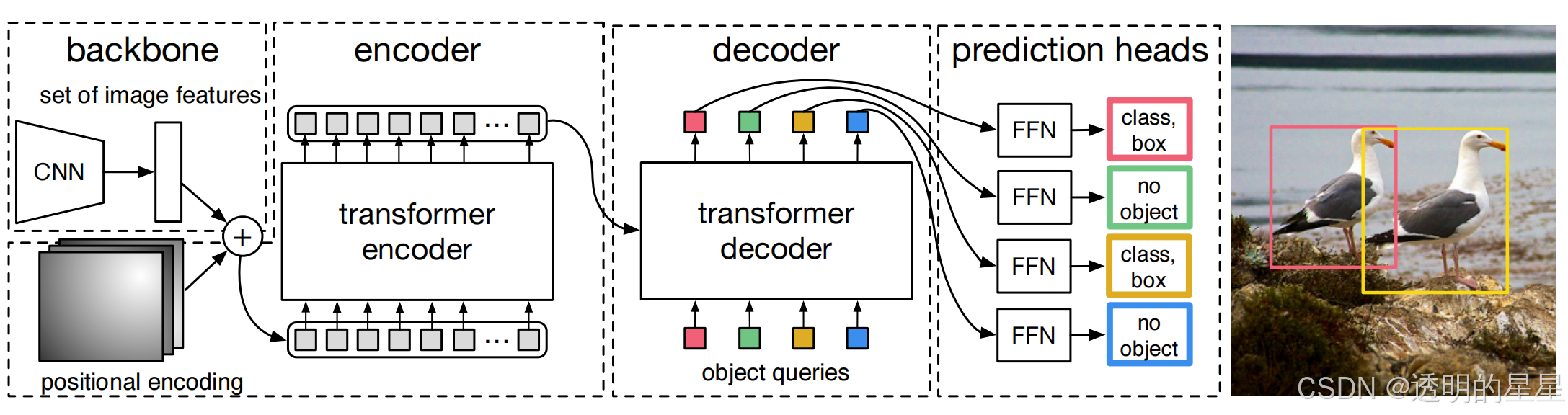
DETR组成部分介绍
骨干网络
位置编码
DETR源码中提供了两种位置编码,
第一种非常接近于原始Transformer论文中的位置编码
class PositionEmbeddingSine(nn.Module):
    """
    This is a more standard version of the position embedding, very similar to the one
    used by the Attention is all you need paper, generalized to work on images.
    """
    def __init__(self, num_pos_feats=64, temperature=10000, normalize=False, scale=None):
        super().__init__()
        self.num_pos_feats = num_pos_feats
        self.temperature = temperature
        self.normalize = normalize
        if scale is not None and normalize is False:
            raise ValueError("normalize should be True if scale is passed")
        if scale is None:
            scale = 2 * math.pi
        self.scale = scale

    def forward(self, tensor_list: NestedTensor):
        x = tensor_list.tensors
        mask = tensor_list.mask
        assert mask is not None
        not_mask = ~mask
        y_embed = not_mask.cumsum(1, dtype=torch.float32)
        x_embed = not_mask.cumsum(2, dtype=torch.float32)
        if self.normalize:
            eps = 1e-6
            y_embed = y_embed / (y_embed[:, -1:, :] + eps) * self.scale
            x_embed = x_embed / (x_embed[:, :, -1:] + eps) * self.scale

        dim_t = torch.arange(self.num_pos_feats, dtype=torch.float32, device=x.device)
        dim_t = self.temperature ** (2 * (dim_t // 2) / self.num_pos_feats)

        pos_x = x_embed[:, :, :, None] / dim_t
        pos_y = y_embed[:, :, :, None] / dim_t
        pos_x = torch.stack((pos_x[:, :, :, 0::2].sin(), pos_x[:, :, :, 1::2].cos()), dim=4).flatten(3)
        pos_y = torch.stack((pos_y[:, :, :, 0::2].sin(), pos_y[:, :, :, 1::2].cos()), dim=4).flatten(3)
        pos = torch.cat((pos_y, pos_x), dim=3).permute(0, 3, 1, 2)
        return pos
第二种是绝对位置编码
class PositionEmbeddingLearned(nn.Module):
    """
    Absolute pos embedding, learned.
    """
    def __init__(self, num_pos_feats=256):
        super().__init__()
        self.row_embed = nn.Embedding(50, num_pos_feats)
        self.col_embed = nn.Embedding(50, num_pos_feats)
        self.reset_parameters()

    def reset_parameters(self):
        nn.init.uniform_(self.row_embed.weight)
        nn.init.uniform_(self.col_embed.weight)

    def forward(self, tensor_list: NestedTensor):
        x = tensor_list.tensors
        h, w = x.shape[-2:]
        i = torch.arange(w, device=x.device)
        j = torch.arange(h, device=x.device)
        x_emb = self.col_embed(i)
        y_emb = self.row_embed(j)
        pos = torch.cat([
            x_emb.unsqueeze(0).repeat(h, 1, 1),
            y_emb.unsqueeze(1).repeat(1, w, 1),
        ], dim=-1).permute(2, 0, 1).unsqueeze(0).repeat(x.shape[0], 1, 1, 1)
        return pos
Transformer编码器
class TransformerEncoder(nn.Module):

    def __init__(self, encoder_layer, num_layers, norm=None):
        super().__init__()
        self.layers = _get_clones(encoder_layer, num_layers)
        self.num_layers = num_layers
        self.norm = norm

    def forward(self, src,
                mask: Optional[Tensor] = None,
                src_key_padding_mask: Optional[Tensor] = None,
                pos: Optional[Tensor] = None):
        output = src

        for layer in self.layers:
            output = layer(output, src_mask=mask,
                           src_key_padding_mask=src_key_padding_mask, pos=pos)

        if self.norm is not None:
            output = self.norm(output)

        return output


class TransformerEncoderLayer(nn.Module):

    def __init__(self, d_model, nhead, dim_feedforward=2048, dropout=0.1,
                 activation="relu", normalize_before=False):
        super().__init__()
        self.self_attn = nn.MultiheadAttention(d_model, nhead, dropout=dropout)
        # Implementation of Feedforward model
        self.linear1 = nn.Linear(d_model, dim_feedforward)
        self.dropout = nn.Dropout(dropout)
        self.linear2 = nn.Linear(dim_feedforward, d_model)

        self.norm1 = nn.LayerNorm(d_model)
        self.norm2 = nn.LayerNorm(d_model)
        self.dropout1 = nn.Dropout(dropout)
        self.dropout2 = nn.Dropout(dropout)

        self.activation = _get_activation_fn(activation)
        self.normalize_before = normalize_before

    def with_pos_embed(self, tensor, pos: Optional[Tensor]):
        return tensor if pos is None else tensor + pos

    def forward_post(self,
                     src,
                     src_mask: Optional[Tensor] = None,
                     src_key_padding_mask: Optional[Tensor] = None,
                     pos: Optional[Tensor] = None):
        q = k = self.with_pos_embed(src, pos)
        src2 = self.self_attn(q, k, value=src, attn_mask=src_mask,
                              key_padding_mask=src_key_padding_mask)[0]
        src = src + self.dropout1(src2)
        src = self.norm1(src)
        src2 = self.linear2(self.dropout(self.activation(self.linear1(src))))
        src = src + self.dropout2(src2)
        src = self.norm2(src)
        return src

    def forward_pre(self, src,
                    src_mask: Optional[Tensor] = None,
                    src_key_padding_mask: Optional[Tensor] = None,
                    pos: Optional[Tensor] = None):
        src2 = self.norm1(src)
        q = k = self.with_pos_embed(src2, pos)
        src2 = self.self_attn(q, k, value=src2, attn_mask=src_mask,
                              key_padding_mask=src_key_padding_mask)[0]
        src = src + self.dropout1(src2)
        src2 = self.norm2(src)
        src2 = self.linear2(self.dropout(self.activation(self.linear1(src2))))
        src = src + self.dropout2(src2)
        return src

    def forward(self, src,
                src_mask: Optional[Tensor] = None,
                src_key_padding_mask: Optional[Tensor] = None,
                pos: Optional[Tensor] = None):
        if self.normalize_before:
            return self.forward_pre(src, src_mask, src_key_padding_mask, pos)
        return self.forward_post(src, src_mask, src_key_padding_mask, pos)
Transformer解码器
class TransformerDecoder(nn.Module):

    def __init__(self, decoder_layer, num_layers, norm=None, return_intermediate=False):
        super().__init__()
        self.layers = _get_clones(decoder_layer, num_layers)
        self.num_layers = num_layers
        self.norm = norm
        self.return_intermediate = return_intermediate

    def forward(self, tgt, memory,
                tgt_mask: Optional[Tensor] = None,
                memory_mask: Optional[Tensor] = None,
                tgt_key_padding_mask: Optional[Tensor] = None,
                memory_key_padding_mask: Optional[Tensor] = None,
                pos: Optional[Tensor] = None,
                query_pos: Optional[Tensor] = None):
        output = tgt

        intermediate = []

        for layer in self.layers:
            output = layer(output, memory, tgt_mask=tgt_mask,
                           memory_mask=memory_mask,
                           tgt_key_padding_mask=tgt_key_padding_mask,
                           memory_key_padding_mask=memory_key_padding_mask,
                           pos=pos, query_pos=query_pos)
            if self.return_intermediate:
                intermediate.append(self.norm(output))

        if self.norm is not None:
            output = self.norm(output)
            if self.return_intermediate:
                intermediate.pop()
                intermediate.append(output)

        if self.return_intermediate:
            return torch.stack(intermediate)

        return output.unsqueeze(0)


class TransformerDecoderLayer(nn.Module):

    def __init__(self, d_model, nhead, dim_feedforward=2048, dropout=0.1,
                 activation="relu", normalize_before=False):
        super().__init__()
        self.self_attn = nn.MultiheadAttention(d_model, nhead, dropout=dropout)
        self.multihead_attn = nn.MultiheadAttention(d_model, nhead, dropout=dropout)
        # Implementation of Feedforward model
        self.linear1 = nn.Linear(d_model, dim_feedforward)
        self.dropout = nn.Dropout(dropout)
        self.linear2 = nn.Linear(dim_feedforward, d_model)

        self.norm1 = nn.LayerNorm(d_model)
        self.norm2 = nn.LayerNorm(d_model)
        self.norm3 = nn.LayerNorm(d_model)
        self.dropout1 = nn.Dropout(dropout)
        self.dropout2 = nn.Dropout(dropout)
        self.dropout3 = nn.Dropout(dropout)

        self.activation = _get_activation_fn(activation)
        self.normalize_before = normalize_before

    def with_pos_embed(self, tensor, pos: Optional[Tensor]):
        return tensor if pos is None else tensor + pos

    def forward_post(self, tgt, memory,
                     tgt_mask: Optional[Tensor] = None,
                     memory_mask: Optional[Tensor] = None,
                     tgt_key_padding_mask: Optional[Tensor] = None,
                     memory_key_padding_mask: Optional[Tensor] = None,
                     pos: Optional[Tensor] = None,
                     query_pos: Optional[Tensor] = None):
        q = k = self.with_pos_embed(tgt, query_pos)
        tgt2 = self.self_attn(q, k, value=tgt, attn_mask=tgt_mask,
                              key_padding_mask=tgt_key_padding_mask)[0]
        tgt = tgt + self.dropout1(tgt2)
        tgt = self.norm1(tgt)
        tgt2 = self.multihead_attn(query=self.with_pos_embed(tgt, query_pos),
                                   key=self.with_pos_embed(memory, pos),
                                   value=memory, attn_mask=memory_mask,
                                   key_padding_mask=memory_key_padding_mask)[0]
        tgt = tgt + self.dropout2(tgt2)
        tgt = self.norm2(tgt)
        tgt2 = self.linear2(self.dropout(self.activation(self.linear1(tgt))))
        tgt = tgt + self.dropout3(tgt2)
        tgt = self.norm3(tgt)
        return tgt

    def forward_pre(self, tgt, memory,
                    tgt_mask: Optional[Tensor] = None,
                    memory_mask: Optional[Tensor] = None,
                    tgt_key_padding_mask: Optional[Tensor] = None,
                    memory_key_padding_mask: Optional[Tensor] = None,
                    pos: Optional[Tensor] = None,
                    query_pos: Optional[Tensor] = None):
        tgt2 = self.norm1(tgt)
        q = k = self.with_pos_embed(tgt2, query_pos)
        tgt2 = self.self_attn(q, k, value=tgt2, attn_mask=tgt_mask,
                              key_padding_mask=tgt_key_padding_mask)[0]
        tgt = tgt + self.dropout1(tgt2)
        tgt2 = self.norm2(tgt)
        tgt2 = self.multihead_attn(query=self.with_pos_embed(tgt2, query_pos),
                                   key=self.with_pos_embed(memory, pos),
                                   value=memory, attn_mask=memory_mask,
                                   key_padding_mask=memory_key_padding_mask)[0]
        tgt = tgt + self.dropout2(tgt2)
        tgt2 = self.norm3(tgt)
        tgt2 = self.linear2(self.dropout(self.activation(self.linear1(tgt2))))
        tgt = tgt + self.dropout3(tgt2)
        return tgt

    def forward(self, tgt, memory,
                tgt_mask: Optional[Tensor] = None,
                memory_mask: Optional[Tensor] = None,
                tgt_key_padding_mask: Optional[Tensor] = None,
                memory_key_padding_mask: Optional[Tensor] = None,
                pos: Optional[Tensor] = None,
                query_pos: Optional[Tensor] = None):
        if self.normalize_before:
            return self.forward_pre(tgt, memory, tgt_mask, memory_mask,
                                    tgt_key_padding_mask, memory_key_padding_mask, pos, query_pos)
        return self.forward_post(tgt, memory, tgt_mask, memory_mask,
                                 tgt_key_padding_mask, memory_key_padding_mask, pos, query_pos)
分配策略
class HungarianMatcher(nn.Module):
    """This class computes an assignment between the targets and the predictions of the network

    For efficiency reasons, the targets don't include the no_object. Because of this, in general,
    there are more predictions than targets. In this case, we do a 1-to-1 matching of the best predictions,
    while the others are un-matched (and thus treated as non-objects).
    """

    def __init__(self, cost_class: float = 1, cost_bbox: float = 1, cost_giou: float = 1):
        """Creates the matcher

        Params:
            cost_class: This is the relative weight of the classification error in the matching cost
            cost_bbox: This is the relative weight of the L1 error of the bounding box coordinates in the matching cost
            cost_giou: This is the relative weight of the giou loss of the bounding box in the matching cost
        """
        super().__init__()
        self.cost_class = cost_class
        self.cost_bbox = cost_bbox
        self.cost_giou = cost_giou
        assert cost_class != 0 or cost_bbox != 0 or cost_giou != 0, "all costs cant be 0"

    @torch.no_grad()
    def forward(self, outputs, targets):
        """ Performs the matching

        Params:
            outputs: This is a dict that contains at least these entries:
                 "pred_logits": Tensor of dim [batch_size, num_queries, num_classes] with the classification logits
                 "pred_boxes": Tensor of dim [batch_size, num_queries, 4] with the predicted box coordinates

            targets: This is a list of targets (len(targets) = batch_size), where each target is a dict containing:
                 "labels": Tensor of dim [num_target_boxes] (where num_target_boxes is the number of ground-truth
                           objects in the target) containing the class labels
                 "boxes": Tensor of dim [num_target_boxes, 4] containing the target box coordinates

        Returns:
            A list of size batch_size, containing tuples of (index_i, index_j) where:
                - index_i is the indices of the selected predictions (in order)
                - index_j is the indices of the corresponding selected targets (in order)
            For each batch element, it holds:
                len(index_i) = len(index_j) = min(num_queries, num_target_boxes)
        """
        bs, num_queries = outputs["pred_logits"].shape[:2]

        # We flatten to compute the cost matrices in a batch
        out_prob = outputs["pred_logits"].flatten(0, 1).softmax(-1)  # [batch_size * num_queries, num_classes]
        out_bbox = outputs["pred_boxes"].flatten(0, 1)  # [batch_size * num_queries, 4]

        # Also concat the target labels and boxes
        tgt_ids = torch.cat([v["labels"] for v in targets])
        tgt_bbox = torch.cat([v["boxes"] for v in targets])

        # Compute the classification cost. Contrary to the loss, we don't use the NLL,
        # but approximate it in 1 - proba[target class].
        # The 1 is a constant that doesn't change the matching, it can be ommitted.
        cost_class = -out_prob[:, tgt_ids]

        # Compute the L1 cost between boxes
        cost_bbox = torch.cdist(out_bbox, tgt_bbox, p=1)

        # Compute the giou cost betwen boxes
        cost_giou = -generalized_box_iou(box_cxcywh_to_xyxy(out_bbox), box_cxcywh_to_xyxy(tgt_bbox))

        # Final cost matrix
        C = self.cost_bbox * cost_bbox + self.cost_class * cost_class + self.cost_giou * cost_giou
        C = C.view(bs, num_queries, -1).cpu()

        sizes = [len(v["boxes"]) for v in targets]
        indices = [linear_sum_assignment(c[i]) for i, c in enumerate(C.split(sizes, -1))]
        return [(torch.as_tensor(i, dtype=torch.int64), torch.as_tensor(j, dtype=torch.int64)) for i, j in indices]
损失函数
class SetCriterion(nn.Module):
    """ This class computes the loss for DETR.
    The process happens in two steps:
        1) we compute hungarian assignment between ground truth boxes and the outputs of the model
        2) we supervise each pair of matched ground-truth / prediction (supervise class and box)
    """
    def __init__(self, num_classes, matcher, weight_dict, eos_coef, losses):
        """ Create the criterion.
        Parameters:
            num_classes: number of object categories, omitting the special no-object category
            matcher: module able to compute a matching between targets and proposals
            weight_dict: dict containing as key the names of the losses and as values their relative weight.
            eos_coef: relative classification weight applied to the no-object category
            losses: list of all the losses to be applied. See get_loss for list of available losses.
        """
        super().__init__()
        self.num_classes = num_classes
        self.matcher = matcher
        self.weight_dict = weight_dict
        self.eos_coef = eos_coef
        self.losses = losses
        empty_weight = torch.ones(self.num_classes + 1)
        empty_weight[-1] = self.eos_coef
        self.register_buffer('empty_weight', empty_weight)

    def loss_labels(self, outputs, targets, indices, num_boxes, log=True):
        """Classification loss (NLL)
        targets dicts must contain the key "labels" containing a tensor of dim [nb_target_boxes]
        """
        assert 'pred_logits' in outputs
        src_logits = outputs['pred_logits']

        idx = self._get_src_permutation_idx(indices)
        target_classes_o = torch.cat([t["labels"][J] for t, (_, J) in zip(targets, indices)])
        target_classes = torch.full(src_logits.shape[:2], self.num_classes,
                                    dtype=torch.int64, device=src_logits.device)
        target_classes[idx] = target_classes_o

        loss_ce = F.cross_entropy(src_logits.transpose(1, 2), target_classes, self.empty_weight)
        losses = {'loss_ce': loss_ce}

        if log:
            # TODO this should probably be a separate loss, not hacked in this one here
            losses['class_error'] = 100 - accuracy(src_logits[idx], target_classes_o)[0]
        return losses

    @torch.no_grad()
    def loss_cardinality(self, outputs, targets, indices, num_boxes):
        """ Compute the cardinality error, ie the absolute error in the number of predicted non-empty boxes
        This is not really a loss, it is intended for logging purposes only. It doesn't propagate gradients
        """
        pred_logits = outputs['pred_logits']
        device = pred_logits.device
        tgt_lengths = torch.as_tensor([len(v["labels"]) for v in targets], device=device)
        # Count the number of predictions that are NOT "no-object" (which is the last class)
        card_pred = (pred_logits.argmax(-1) != pred_logits.shape[-1] - 1).sum(1)
        card_err = F.l1_loss(card_pred.float(), tgt_lengths.float())
        losses = {'cardinality_error': card_err}
        return losses

    def loss_boxes(self, outputs, targets, indices, num_boxes):
        """Compute the losses related to the bounding boxes, the L1 regression loss and the GIoU loss
           targets dicts must contain the key "boxes" containing a tensor of dim [nb_target_boxes, 4]
           The target boxes are expected in format (center_x, center_y, w, h), normalized by the image size.
        """
        assert 'pred_boxes' in outputs
        idx = self._get_src_permutation_idx(indices)
        src_boxes = outputs['pred_boxes'][idx]
        target_boxes = torch.cat([t['boxes'][i] for t, (_, i) in zip(targets, indices)], dim=0)

        loss_bbox = F.l1_loss(src_boxes, target_boxes, reduction='none')

        losses = {}
        losses['loss_bbox'] = loss_bbox.sum() / num_boxes

        loss_giou = 1 - torch.diag(box_ops.generalized_box_iou(
            box_ops.box_cxcywh_to_xyxy(src_boxes),
            box_ops.box_cxcywh_to_xyxy(target_boxes)))
        losses['loss_giou'] = loss_giou.sum() / num_boxes
        return losses

    def loss_masks(self, outputs, targets, indices, num_boxes):
        """Compute the losses related to the masks: the focal loss and the dice loss.
           targets dicts must contain the key "masks" containing a tensor of dim [nb_target_boxes, h, w]
        """
        assert "pred_masks" in outputs

        src_idx = self._get_src_permutation_idx(indices)
        tgt_idx = self._get_tgt_permutation_idx(indices)
        src_masks = outputs["pred_masks"]
        src_masks = src_masks[src_idx]
        masks = [t["masks"] for t in targets]
        # TODO use valid to mask invalid areas due to padding in loss
        target_masks, valid = nested_tensor_from_tensor_list(masks).decompose()
        target_masks = target_masks.to(src_masks)
        target_masks = target_masks[tgt_idx]

        # upsample predictions to the target size
        src_masks = interpolate(src_masks[:, None], size=target_masks.shape[-2:],
                                mode="bilinear", align_corners=False)
        src_masks = src_masks[:, 0].flatten(1)

        target_masks = target_masks.flatten(1)
        target_masks = target_masks.view(src_masks.shape)
        losses = {
            "loss_mask": sigmoid_focal_loss(src_masks, target_masks, num_boxes),
            "loss_dice": dice_loss(src_masks, target_masks, num_boxes),
        }
        return losses

    def _get_src_permutation_idx(self, indices):
        # permute predictions following indices
        batch_idx = torch.cat([torch.full_like(src, i) for i, (src, _) in enumerate(indices)])
        src_idx = torch.cat([src for (src, _) in indices])
        return batch_idx, src_idx

    def _get_tgt_permutation_idx(self, indices):
        # permute targets following indices
        batch_idx = torch.cat([torch.full_like(tgt, i) for i, (_, tgt) in enumerate(indices)])
        tgt_idx = torch.cat([tgt for (_, tgt) in indices])
        return batch_idx, tgt_idx

    def get_loss(self, loss, outputs, targets, indices, num_boxes, **kwargs):
        loss_map = {
            'labels': self.loss_labels,
            'cardinality': self.loss_cardinality,
            'boxes': self.loss_boxes,
            'masks': self.loss_masks
        }
        assert loss in loss_map, f'do you really want to compute {loss} loss?'
        return loss_map[loss](outputs, targets, indices, num_boxes, **kwargs)

    def forward(self, outputs, targets):
        """ This performs the loss computation.
        Parameters:
             outputs: dict of tensors, see the output specification of the model for the format
             targets: list of dicts, such that len(targets) == batch_size.
                      The expected keys in each dict depends on the losses applied, see each loss' doc
        """
        outputs_without_aux = {k: v for k, v in outputs.items() if k != 'aux_outputs'}

        # Retrieve the matching between the outputs of the last layer and the targets
        indices = self.matcher(outputs_without_aux, targets)

        # Compute the average number of target boxes accross all nodes, for normalization purposes
        num_boxes = sum(len(t["labels"]) for t in targets)
        num_boxes = torch.as_tensor([num_boxes], dtype=torch.float, device=next(iter(outputs.values())).device)
        if is_dist_avail_and_initialized():
            torch.distributed.all_reduce(num_boxes)
        num_boxes = torch.clamp(num_boxes / get_world_size(), min=1).item()

        # Compute all the requested losses
        losses = {}
        for loss in self.losses:
            losses.update(self.get_loss(loss, outputs, targets, indices, num_boxes))

        # In case of auxiliary losses, we repeat this process with the output of each intermediate layer.
        if 'aux_outputs' in outputs:
            for i, aux_outputs in enumerate(outputs['aux_outputs']):
                indices = self.matcher(aux_outputs, targets)
                for loss in self.losses:
                    if loss == 'masks':
                        # Intermediate masks losses are too costly to compute, we ignore them.
                        continue
                    kwargs = {}
                    if loss == 'labels':
                        # Logging is enabled only for the last layer
                        kwargs = {'log': False}
                    l_dict = self.get_loss(loss, aux_outputs, targets, indices, num_boxes, **kwargs)
                    l_dict = {k + f'_{i}': v for k, v in l_dict.items()}
                    losses.update(l_dict)

        return losses
更多推荐
 9
9 0
0- 0


 已为社区贡献2条内容

所有评论(0)