
机器视觉作业--Gammma
·
参考博客:https://blog.csdn.net/lxy201700/article/details/24929013
代码:
#include <opencv2/opencv.hpp>
#include <iostream>
#include <math.h>
using namespace std;

using namespace cv; //下面的所有cv相关类型不用加上前缀了


int main()
{
    Mat img = imread("D://C++//cup.jpg");
    imshow("img", img);
    Mat& src = img;
    Mat& MyGammaCorrection(Mat & src, float fGamma);
    if (!img.data)
        return -1;
    float fGamma = 1 / 2.2;
    MyGammaCorrection(img, fGamma);
    //namedWindow("dst", CV_WINDOW_AUTOSIZE);
    imshow("dst", src);

    waitKey(0);
    return 0;
}


Mat& MyGammaCorrection(Mat& src, float fGamma)
{
    CV_Assert(src.data);  //若括号中的表达式为false,则返回一个错误的信息。

    // accept only char type matrices
    CV_Assert(src.depth() != sizeof(uchar));
    // build look up table
    unsigned char lut[256];
    for (int i = 0; i < 256; i++)
    {
        lut[i] = pow((float)(i / 255.0), fGamma) * 255.0;
    }
    //先归一化,i/255,然后进行预补偿(i/255)^fGamma,最后进行反归一化(i/255)^fGamma*255

    const int channels = src.channels();
    switch (channels)
    {
    case 1:
    {
        //运用迭代器访问矩阵元素
        MatIterator_<uchar> it, end;
        for (it = src.begin<uchar>(), end = src.end<uchar>(); it != end; it++)
            //*it = pow((float)(((*it))/255.0), fGamma) * 255.0;
            *it = lut[(*it)];

        break;
    }
    case 3:
    {

        MatIterator_<Vec3b> it, end;
        for (it = src.begin<Vec3b>(), end = src.end<Vec3b>(); it != end; it++)
        {
            //(*it)[0] = pow((float)(((*it)[0])/255.0), fGamma) * 255.0;
            //(*it)[1] = pow((float)(((*it)[1])/255.0), fGamma) * 255.0;
            //(*it)[2] = pow((float)(((*it)[2])/255.0), fGamma) * 255.0;
            (*it)[0] = lut[((*it)[0])];
            (*it)[1] = lut[((*it)[1])];
            (*it)[2] = lut[((*it)[2])];
        }

        break;

    }
    }

    return src;
}
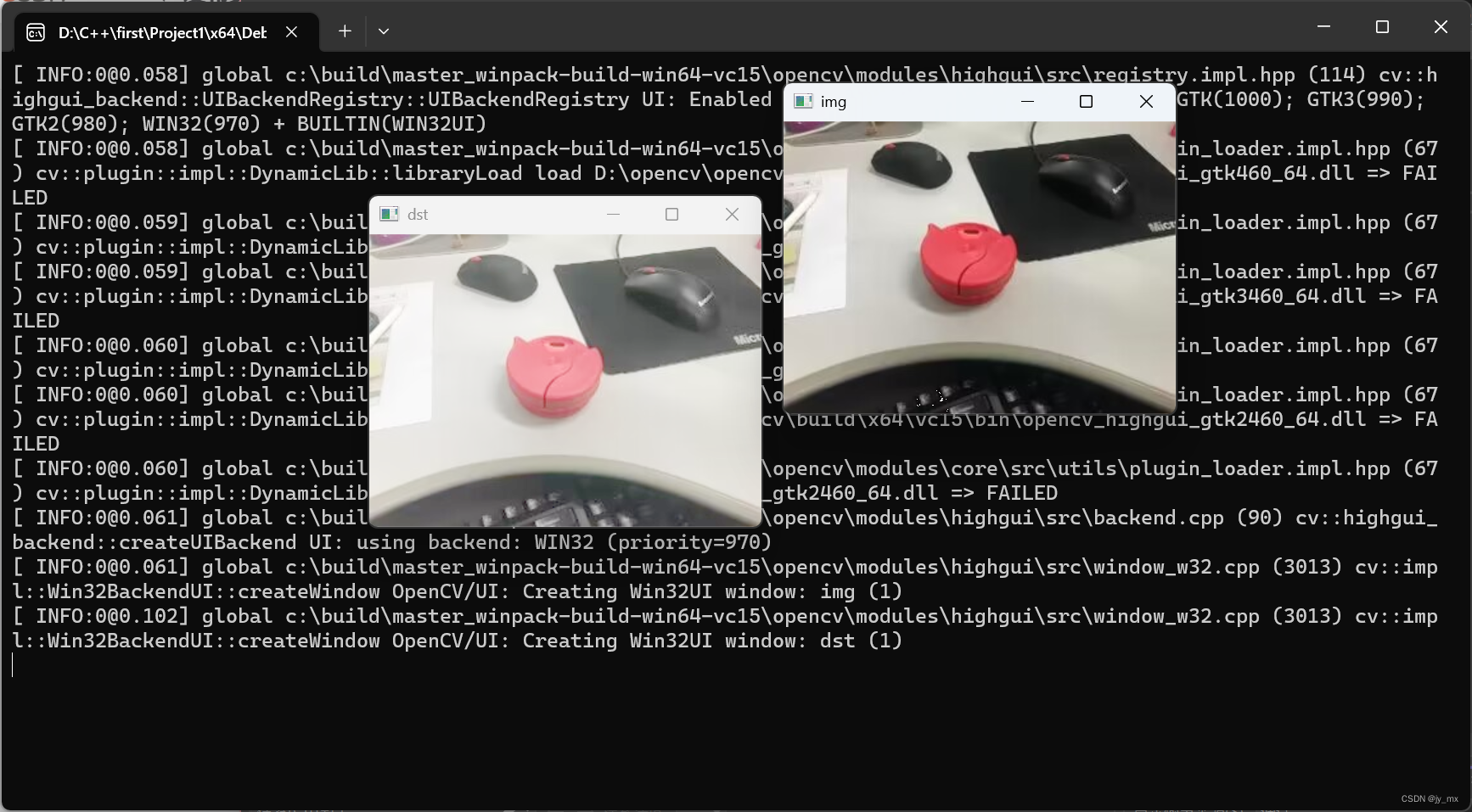
效果:
更多推荐


 0
0 0
0- 0


 已为社区贡献2条内容

所有评论(0)