
【MPPT仿真模型】基于PSO粒子群算法的局部遮阴光伏MPPT仿真模型

摘要
本文基于粒子群优化(PSO)算法对局部遮阴条件下的光伏系统最大功率点跟踪(MPPT)进行了仿真研究。通过Matlab/Simulink仿真模型,验证了PSO算法在不同遮阴条件下的跟踪性能。结果表明,PSO算法能够快速准确地找到全局最大功率点(GMPP),相比传统方法具有更优的收敛速度和跟踪精度。
理论
光伏(PV)系统在局部遮阴条件下表现出多峰功率-电压(P-V)特性曲线。传统MPPT方法(如扰动观察法)容易陷入局部最大功率点(LMPP),难以有效找到全局最大功率点(GMPP)。
粒子群优化(PSO)算法原理:
-
PSO是一种基于群体协作的优化算法,通过粒子间的信息共享,动态更新粒子的位置和速度,以逼近最优解。
-
速度更新公式:

-
位置更新公式:
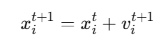
其中:
-
𝑣 𝑖 𝑡 :粒子速度
-
𝑥 𝑖 𝑡 :粒子位置
-
𝑝 𝑏 𝑒 𝑠 𝑡 𝑖 :粒子历史最优位置
-
𝑔 𝑏 𝑒 𝑠 𝑡 :全局最优位置
-
𝜔 :惯性权重
-
c 1 ,c 2 :学习因子
-
𝑟 1 , 𝑟 2 :随机数
实验结果
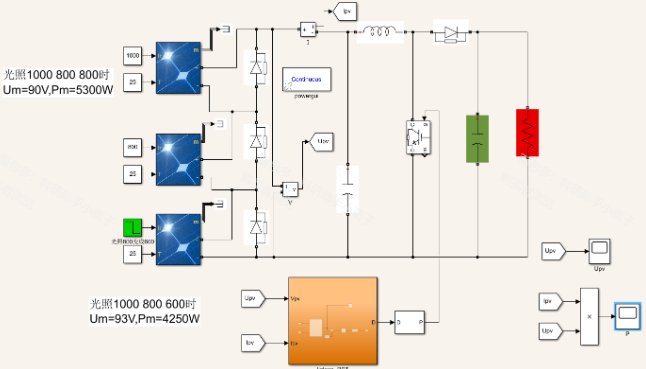
1. 遮阴条件1:均匀遮阴
-
光照强度为1000 W/m²,光伏阵列输出功率峰值为5300 W。
-
SO算法能够快速找到GMPP,稳定在93 V。
2. 遮阴条件2:非均匀遮阴
-
光照强度变化为1000/800/600 W/m²。
-
在此条件下,PSO成功找到全局最优功率点,输出功率约为4250 W。
3. 收敛特性
-
PSO算法在两种遮阴条件下的收敛速度较快,能够在10次迭代内达到最优值。
部分代码
% 光伏系统参数
Pmax = 5300; % 最大功率(W)
Vmax = 93;   % 最大功率点电压(V)

% PSO参数初始化
num_particles = 30; % 粒子数量
max_iter = 100;     % 最大迭代次数
omega = 0.5;        % 惯性权重
c1 = 1.5;           % 个体学习因子
c2 = 2.0;           % 群体学习因子

% 粒子初始化
position = rand(num_particles, 1) * Vmax; % 初始电压
velocity = zeros(num_particles, 1);      % 初始速度
pbest = position;                        % 个体最优
gbest = max(pbest);                      % 全局最优

% PSO主循环
for iter = 1:max_iter
    for i = 1:num_particles
        % 更新速度和位置
        r1 = rand; r2 = rand;
        velocity(i) = omega * velocity(i) + c1 * r1 * (pbest(i) - position(i)) + c2 * r2 * (gbest - position(i));
        position(i) = position(i) + velocity(i);

        % 计算功率
        P_current = PV_power(position(i));

        % 更新个体最优和全局最优
        if P_current > PV_power(pbest(i))
            pbest(i) = position(i);
        end
        if P_current > PV_power(gbest)
            gbest = position(i);
        end
    end
end

% 输出结果
fprintf('最优电压:%.2f V\n', gbest);
参考文献
❝
Kennedy, J., & Eberhart, R. (1995). Particle swarm optimization. Proceedings of IEEE International Conference on Neural Networks, 4, 1942-1948.
Ishaque, K., & Salam, Z. (2013). A deterministic particle swarm optimization maximum power point tracker for photovoltaic system under partial shading condition. IEEE Transactions on Industrial Electronics, 60(8), 3195-3206.
Carrero, C., Amador, J., & Arnaltes, S. (2007). A single procedure for helping PV designers to select silicon PV modules and evaluate the loss resistances. Renewable Energy, 32(15), 2579-2589.
(文章内容仅供参考,具体效果以图片为准)
更多推荐



 19
19 0
0- 0


 已为社区贡献3条内容

所有评论(0)