
sparksql源码系列 | 一文搞懂with one count distinct 执行原理
今天下午的源码课,主要是对上两次课程中留的作业的讲解,除了几个逻辑执行计划的优化器外, 重点是planAggregateWithOneDistinct(有一个count distinct情况下生成物理执行计划的原理)。
在面试时,或多或少会被问到有关count distinct的优化,现在离线任务用到的基本就是hivesql和sparksql,那sparksql中有关count distinct做了哪些优化呢?
实际上sparksql中count distinct执行原理可以从两个点来说明:
-
with one count distinct
-
more than one count distinct
这篇文章主要聊一聊 with one count distinct,如果你正好也想了解这块,就点赞、收藏吧~
ps:文中有两个原理的图片比较大,上传上来之后会有点不清晰,如果有需要的朋友可文末加俺,俺发你
本文基于spark 3.2
本文大纲
1、Aggregate函数的几种mode
2、生成WithOneDistinct物理执行计划的几个阶段
3、除了count distinct,没有其他非distinct聚合函数的情况的执行原理
4、除了count distinct,有其他非distinct聚合函数的情况的执行原理
5、关键点调试
6、总结
1、Aggregate函数的几种mode
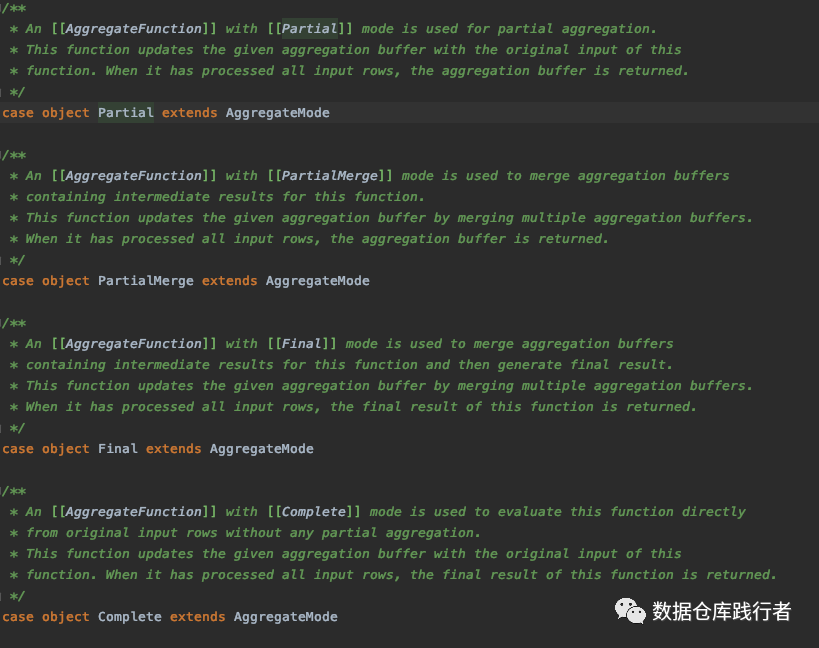
Partial: 局部数据的聚合。会根据读入的原始数据更新对应的聚合缓冲区,当处理完所有的输入数据后,返回的是局部聚合的结果
PartialMerge: 主要是对Partial返回的聚合缓冲区(局部聚合结果)进行合并,但此时仍不是最终结果,还要经过Final才是最终结果(count distinct 类型)
Final: 起到的作用是将聚合缓冲区的数据进行合并,然后返回最终的结果
Complete: 不进行局部聚合计算,应用在不支持Partial模式的聚合函数上(比如求百分位percentile_approx)
非distinct类的聚合函数的路线:Partial --> Final
distinct类的聚合函数的路线:Partial --> PartialMerge --> Partial --> Final
2、生成WithOneDistinct物理执行计划的几个阶段
-
partialAggregate
-
partialMergeAggregate
-
partialDistinctAggregate
-
finalAggregate
3、没有其他非distinct聚合函数的情况下执行原理
sql:
select a,count(distinct b ) from testdata2 group by aOptimized Logical Plan-->Physical Plan-->executedPlan:
== Optimized Logical Plan ==
Aggregate [a#3], [a#3, count(distinct b#4) AS count(DISTINCT b)#11L]
+- SerializeFromObject [knownnotnull(assertnotnull(input[0, org.apache.spark.sql.test.SQLTestData$TestData2, true])).a AS a#3, knownnotnull(assertnotnull(input[0, org.apache.spark.sql.test.SQLTestData$TestData2, true])).b AS b#4]
+- ExternalRDD [obj#2]
== Physical Plan ==
HashAggregate(keys=[a#3], functions=[count(distinct b#4)], output=[a#3, count(DISTINCT b)#11L])
+- HashAggregate(keys=[a#3], functions=[partial_count(distinct b#4)], output=[a#3, count#16L])
+- HashAggregate(keys=[a#3, b#4], functions=[], output=[a#3, b#4])
+- HashAggregate(keys=[a#3, b#4], functions=[], output=[a#3, b#4])
+- SerializeFromObject [knownnotnull(assertnotnull(input[0, org.apache.spark.sql.test.SQLTestData$TestData2, true])).a AS a#3, knownnotnull(assertnotnull(input[0, org.apache.spark.sql.test.SQLTestData$TestData2, true])).b AS b#4]
+- Scan[obj#2]
== executedPlan ==
AdaptiveSparkPlan isFinalPlan=false
+- HashAggregate(keys=[a#3], functions=[count(distinct b#4)], output=[a#3, count(DISTINCT b)#11L])
+- Exchange hashpartitioning(a#3, 5), ENSURE_REQUIREMENTS, [id=#28]
+- HashAggregate(keys=[a#3], functions=[partial_count(distinct b#4)], output=[a#3, count#16L])
+- HashAggregate(keys=[a#3, b#4], functions=[], output=[a#3, b#4])
+- Exchange hashpartitioning(a#3, b#4, 5), ENSURE_REQUIREMENTS, [id=#24]
+- HashAggregate(keys=[a#3, b#4], functions=[], output=[a#3, b#4])
+- SerializeFromObject [knownnotnull(assertnotnull(input[0, org.apache.spark.sql.test.SQLTestData$TestData2, true])).a AS a#3, knownnotnull(assertnotnull(input[0, org.apache.spark.sql.test.SQLTestData$TestData2, true])).b AS b#4]
+- Scan[obj#2]四个阶段的运行原理:
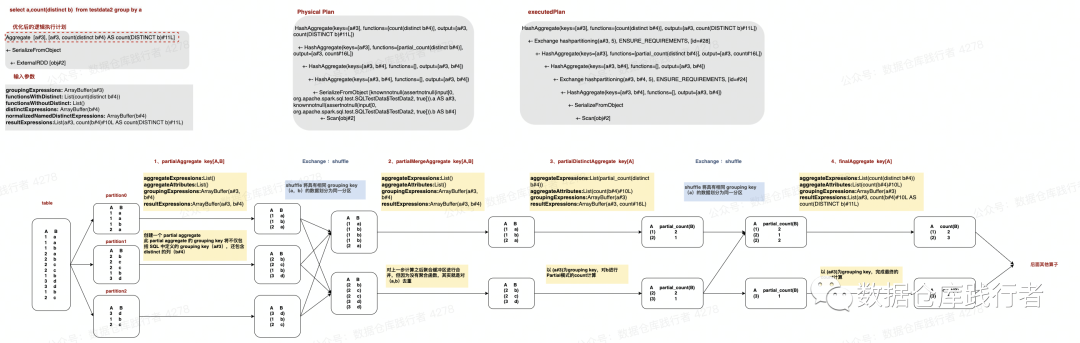
4、有其他非distinct聚合函数的情况下执行原理
sql:
select a,count(distinct b),max(b) from testdata2 group by aOptimized Logical Plan-->Physical Plan-->executedPlan:
== Optimized Logical Plan ==
Aggregate [a#3], [a#3, count(distinct b#4) AS count(DISTINCT b)#12L, max(b#4) AS max(b)#13]
+- SerializeFromObject [knownnotnull(assertnotnull(input[0, org.apache.spark.sql.test.SQLTestData$TestData2, true])).a AS a#3, knownnotnull(assertnotnull(input[0, org.apache.spark.sql.test.SQLTestData$TestData2, true])).b AS b#4]
+- ExternalRDD [obj#2]
== Physical Plan ==
HashAggregate(keys=[a#3], functions=[max(b#4), count(distinct b#4)], output=[a#3, count(DISTINCT b)#12L, max(b)#13])
+- HashAggregate(keys=[a#3], functions=[merge_max(b#4), partial_count(distinct b#4)], output=[a#3, max#18, count#21L])
+- HashAggregate(keys=[a#3, b#4], functions=[merge_max(b#4)], output=[a#3, b#4, max#18])
+- HashAggregate(keys=[a#3, b#4], functions=[partial_max(b#4)], output=[a#3, b#4, max#18])
+- SerializeFromObject [knownnotnull(assertnotnull(input[0, org.apache.spark.sql.test.SQLTestData$TestData2, true])).a AS a#3, knownnotnull(assertnotnull(input[0, org.apache.spark.sql.test.SQLTestData$TestData2, true])).b AS b#4]
+- Scan[obj#2]
== executedPlan ==
AdaptiveSparkPlan isFinalPlan=false
+- HashAggregate(keys=[a#3], functions=[max(b#4), count(distinct b#4)], output=[a#3, count(DISTINCT b)#12L, max(b)#13])
+- Exchange hashpartitioning(a#3, 5), ENSURE_REQUIREMENTS, [id=#28]
+- HashAggregate(keys=[a#3], functions=[merge_max(b#4), partial_count(distinct b#4)], output=[a#3, max#18, count#21L])
+- HashAggregate(keys=[a#3, b#4], functions=[merge_max(b#4)], output=[a#3, b#4, max#18])
+- Exchange hashpartitioning(a#3, b#4, 5), ENSURE_REQUIREMENTS, [id=#24]
+- HashAggregate(keys=[a#3, b#4], functions=[partial_max(b#4)], output=[a#3, b#4, max#18])
+- SerializeFromObject [knownnotnull(assertnotnull(input[0, org.apache.spark.sql.test.SQLTestData$TestData2, true])).a AS a#3, knownnotnull(assertnotnull(input[0, org.apache.spark.sql.test.SQLTestData$TestData2, true])).b AS b#4]
+- Scan[obj#2]四个阶段的运行原理:
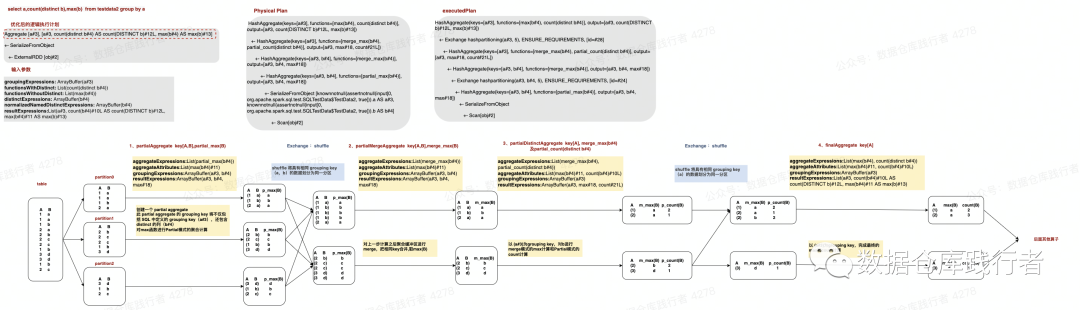
5、关键点调试
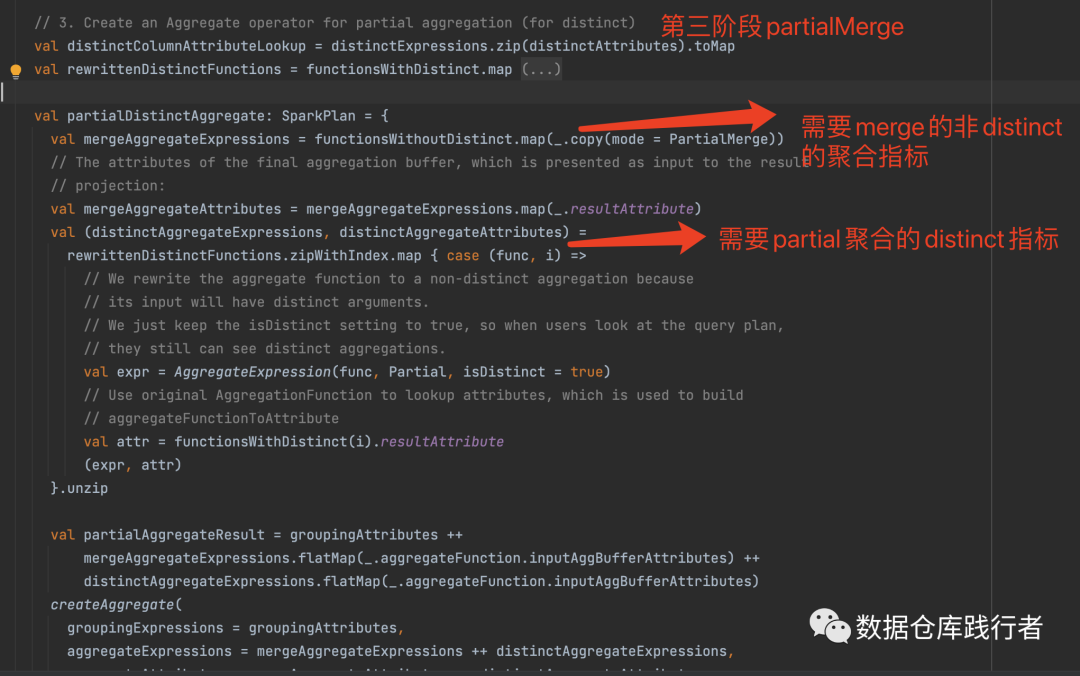
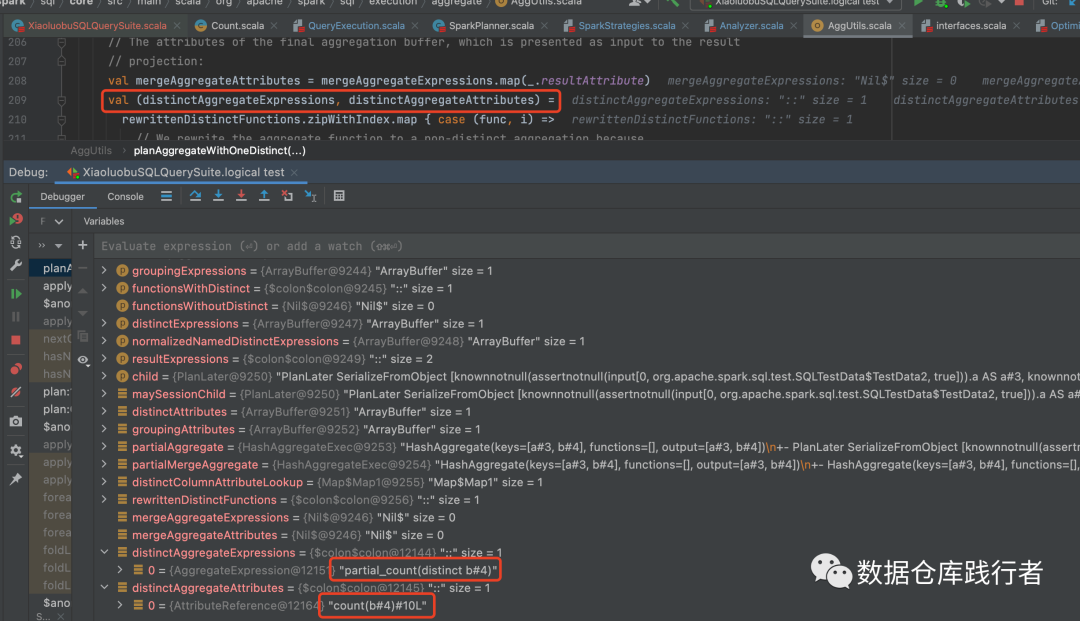
distinctAggregateExpressions-->带distinct聚合函数的表达式
distinctAggregateAttributes-->带distinct聚合函数的引用
val (distinctAggregateExpressions, distinctAggregateAttributes) =
        rewrittenDistinctFunctions.zipWithIndex.map { case (func, i) =>
          // We rewrite the aggregate function to a non-distinct aggregation because
          // its input will have distinct arguments.
          // We just keep the isDistinct setting to true, so when users look at the query plan,
          // they still can see distinct aggregations.
          val expr = AggregateExpression(func, Partial, isDistinct = true)
          // Use original AggregationFunction to lookup attributes, which is used to build
          // aggregateFunctionToAttribute
          val attr = functionsWithDistinct(i).resultAttribute
          (expr, attr)
      }.unzip
debug结果:
6、总结
我们对hive的count(distinct)做优化,怎么做? 先group by,再count
Sparksql with one count(distinct) 的情况,相比于hive来说,做了优化
select a,count(distinct b) from testdata2 group by a
等价于
select a,count(b) from (
select a,b from testdata2 group by a,b
) tmp group by a
HashAggregate(keys=[a#3], functions=[count(distinct b#4)], output=[a#3, count(DISTINCT b)#11L])
+- HashAggregate(keys=[a#3], functions=[partial_count(distinct b#4)], output=[a#3, count#16L])
+- HashAggregate(keys=[a#3, b#4], functions=[], output=[a#3, b#4])
+- HashAggregate(keys=[a#3, b#4], functions=[], output=[a#3, b#4])
+- SerializeFromObject
+- Scan[obj#2]
----------------------------------------------------------------------------
HashAggregate(keys=[a#3], functions=[count(1)], output=[a#3, count(b)#11L])
+- HashAggregate(keys=[a#3], functions=[partial_count(1)], output=[a#3, count#15L])
+- HashAggregate(keys=[a#3, b#4], functions=[], output=[a#3])
+- HashAggregate(keys=[a#3, b#4], functions=[], output=[a#3, b#4])
+- SerializeFromObject
+- Scan[obj#2]推荐阅读:
sparksql源码系列 | 最全的logical plan优化规则整理(spark2.3)
Sparksql源码系列 | 读源码必须掌握的scala基础语法
澄清 | snappy压缩到底支持不支持split? 为啥?
Hey!
我是小萝卜算子
欢迎关注:数据仓库践行者
分享是最好的学习,这里记录我对数据仓库的实践的思考和总结
每天学习一点点
知识增加一点点
思考深入一点点
在成为最厉害最厉害最厉害的道路上
很高兴认识你
更多推荐

 0
0 0
0- 0


 已为社区贡献3条内容

所有评论(0)