
Java数据结构(二叉树)
目录
1、什么是二叉树
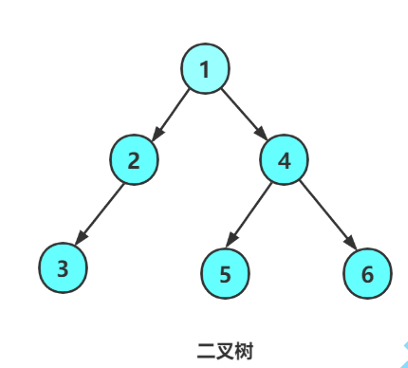
二叉树(Binary Tree) 是一种非线性的数据结构,由节点组成,每个节点最多有两个子节点,通常称为左子节点和右子节点。二叉树可以为空(没有节点),也可以是一个根节点加上两个互不相交的左子树和右子树。如图所示:
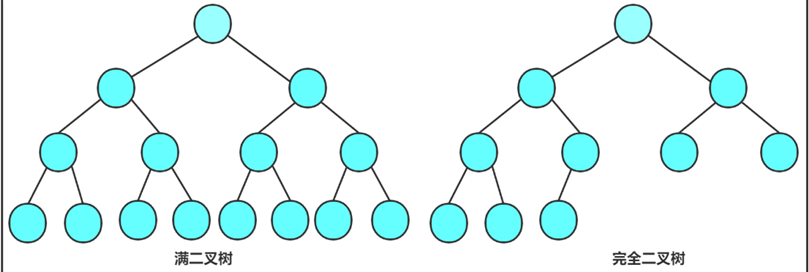
满二叉树和完全二叉树是两种特殊的二叉树结构。
满二叉树:所有层都填满节点的二叉树,即每个节点要么是叶子节点,要么有两个子节点。
完全二叉树:除了最后一层外,其他所有层都被完全填满,并且最后一层的节点全部靠左排列。
2、二叉树的性质
1. 若规定根结点的层数为1,则一棵非空二叉树的第i层上最多有(i>0)个结点
2. 若规定只有根结点的二叉树的深度为1,则深度为K的二叉树的最大结点数是(k>=0)
3. 对任何一棵二叉树, 如果其叶结点个数为 n0, 度为2的非叶结点个数为 n2,则有n0=n2+1
4. 具有n个结点的完全二叉树的深度k为上取整
5. 对于具有n个结点的完全二叉树,如果按照从上至下从左至右的顺序对所有节点从0开始编号,则对于序号为i 的结点有: 若i>0,双亲序号:(i-1)/2;i=0,i为根结点编号,无双亲结点 若2i+1
2.1.二叉树的存储
二叉树的存储结构分为:顺序存储和类似于链表的链式存储,本章中主要讲链式存储。
二叉树的链式存储是通过一个一个的节点引用起来的,常见的表示方式有二叉和三叉表示方式,具体如下:
public class binaryTree {
    public static class TreeNode {
        public char val;
        public TreeNode left;
        public TreeNode right;

        public TreeNode(char val) {
            this.val = val;
        }
    }

    public TreeNode createTree() {
        TreeNode A = new TreeNode('A');
        TreeNode B = new TreeNode('B');
        TreeNode C = new TreeNode('C');
        TreeNode D = new TreeNode('D');
        TreeNode E = new TreeNode('E');
        TreeNode F = new TreeNode('F');
        TreeNode G = new TreeNode('G');
        TreeNode H = new TreeNode('H');

        A.left = B;
        A.right = C;
        B.left = D;
        B.right = E;
        C.left = F;
        C.right = G;
        E.right = H;
        return A;
    }
3.二叉树的遍历
二叉树的遍历分为深度优先遍历和广度优先遍历:
深度优先遍历分为前序遍历(遍历顺序:root -> left -> right),中序遍历,后序遍历。了解一个遍历其他两个就解决了,可以用递归的思想去理解遍历;
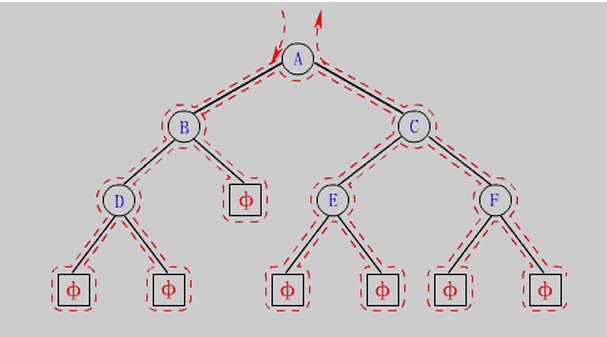
广度优先遍历分为层序遍历(从上向下,逐层遍历)。
了解这几个遍历才可以完成接下来的二叉树的基本操作。
前序遍历(递归):
 public void preOrder(TreeNode root) {
        //当左子树为空时return;
        if (root == null) {
            return;
        }
        System.out.print(root.val + "");
        preOrder(root.left);
        preOrder(root.right);
    }
非递归:
  public List<Character> preTraversal(TreeNode root) {
        List<Character> list = new ArrayList<>();
        if (root == null) {
            return list;
        }
        TreeNode curr = root;
        //用栈的方法实现非递归
        Stack<TreeNode> stack = new Stack<>();
        while (curr != null || !stack.isEmpty()) {
            while (curr != null) {
                //访问一个结点入栈并入队列;
                stack.push(curr);
                list.add(curr.val);
                curr = curr.left;
            }
            //当该结点左子树为空时,出栈去到右子树
            curr = stack.pop();
            curr = curr.right;
        }
        return list;
    }
层序遍历:
pubilc void levelOrder(TreeNode root) {
        //从上而下遍历先进先出,用队列实现
        Queue<TreeNode> queue = new LinkedList<>();
        queue.offer(root);
        while (!queue.isEmpty()) {
            TreeNode curr = queue.poll();
            System.out.print(curr.val);
            if (curr.left != null) {
                queue.offer(curr.left);
            }
            if (curr.right != null) {
                queue.offer(curr.right);
            }
        }
    }
4.二叉树的基本操作
学会二叉树的基本操作后就可以熟练的掌握。
获取树中节点的个数,通过子问题思想图解决,二叉树的结点个数就是左子树的个数加上右子树的个树加上根结点。通过递归去实现:
public int size(TreeNode root) {
        if (root == null) {
            return 0;
        }
        return size(root.left) + size(root.right) + 1;
    }
获取叶子节点的个数,当左为null与右为null时为叶子结点:
int getLeafNodeCount(TreeNode root) {
        if (root == null) {
            return 0;
        }
        if (root.left == null && root.right == null) {
            return 1;
        }
        return getLeafNodeCount(root.left) + getLeafNodeCount(root.right);
    }
获取第K层节点的个数,想要获取第k层的结点,从根结点出发到第k层相当于递归了k-1层;
public int getKLevelNodeCount(TreeNode root, int k) {
        if (root == null) {
            return 0;
        }
        if (k == 1) {
            return 1;
        }
        return getKLevelNodeCount(root.left, k - 1) + getKLevelNodeCount(root.right, k - 1);
    }
获取二叉树的高度,二叉树的高度等于左子树和右子树最大的高度加1:
public int getHeight(TreeNode root) {
        if (root == null) {
            return 0;
        }
        return Math.max(getHeight(root.left), getHeight(root.right)) + 1;
    }
检测值为value的元素是否存在,找到该元素后变直接向上传递
 public TreeNode find(TreeNode root, char val) {
        if (root == null) {
            return null;
        }
        if (root.val == val) {
            return root;
        }
        TreeNode leftT = find(root.left, val);
        if (leftT != null) {
            return leftT;
        }
        TreeNode rightT = find(root.right, val);
        if (rightT != null) {
            return rightT;
        }
        return null;
    }
判断一棵树是不是平衡二叉树On平方时间复杂度情况下,要知道一棵树是不是平衡二叉树就需要知道二叉树的高度,所以可以直接调用上面求二叉树高度的方法
 public boolean isBalanced(TreeNode root) {
        if (root == null) {
            return true;
        }
        int leftHeinght = getHeight(root.left);
        int rightHeinght = getHeight(root.right);
        //绝对值的判断也可以用if语句放在return前面
        return Math.abs(leftHeinght - rightHeinght) < 2 && isBalanced(root.left) && isBalanced(root.right);
    }
完全二叉树,树结点左边有树右边可有可无,但右边有左边没有的话就不是完全二叉树
public boolean isCompleteTree(TreeNode root) {
        if (root == null){
            return true;
        }
        Queue<TreeNode> queue = new LinkedList<>();
        queue.offer(root);
        while (!queue.isEmpty()) {
            TreeNode curr = queue.poll();
            if(curr == null){
                break;
            }
            queue.offer(curr.left);
            queue.offer(curr.right);
        }
        while (!queue.isEmpty()) {
            TreeNode curN = queue.poll();
            if(curN != null){
                return false;
            }
        }
        return true;
    }
5.优先级队列(堆)
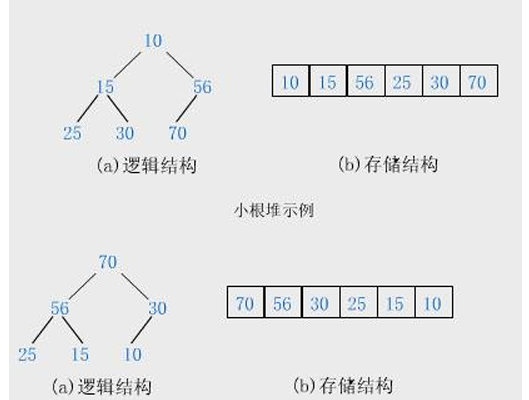
如果有一个关键码的集合K = {k0,k1, k2,…,kn-1},把它的所有元素按完全二叉树的顺序存储方式存储 在一 个一维数组中,并满足:Ki = K2i+1 且 Ki >= K2i+2) i = 0,1,2…,则称为 小堆(或大 堆)。将根节点最大的堆叫做最大堆或大根堆,根节点最小的堆叫做最小堆或小根堆。
5.1堆的创建
import java.util.Arrays;
//用堆在实现优先队列
public class MyHeap {
    public int [] elem;
    public int useSize;

    public MyHeap(){
        this.elem = new int[10];
    }


    public void createHeap(){
        for (int parent = (this.useSize-1-1)/2; parent >= 0 ; parent--) {
            siftDown(parent,this.useSize);
        }
    }
    //向下
    private void siftDown(int parent, int useSize) {
        int child = 2*parent + 1;
        while (child < useSize){
            if (child+1 < useSize && elem[child] < elem[child+1]){
                child++;
            }
            if (elem[child] > elem[parent]){
                swap(child,parent);
                parent = child;
                child = 2*parent + 1;
            }else {
                break;
            }
        }
    }
    public void push(int val){
        if (isFull()){
            elem = Arrays.copyOf(elem,elem.length*2);
        }
        elem[useSize] = val;
        siftUp(useSize);
        useSize ++;
    }
    //用插入元素的方式实现一个向上
    public void  siftUp(int child){
        int parent = (child-1)/2;
        while (child >= 0 ) {
            if (elem[child] > elem[parent]) {
               swap(child,parent);
                child = parent;
                parent = (child - 1) / 2;
            } else {
                break;
            }
        }
    }
    public int poll(int index){
        if (isEmpty()){
            return -1;
        }
        int val = elem[index];
        int child = useSize - 1;
        swap(child, index);
        useSize--;
        siftDown(index , useSize);
        return val;
    }

    public int peek(){
        if (isEmpty()){
            return -1;
        }
        return elem[0];
    }

    public int contains(int[]elem,int val){
        for (int i = 0; i < useSize; i++) {
            if (elem[i] == val){
                return i;
            }
        }
        return -1;
    }
    public  boolean  isFull(){
        return this.useSize == elem.length;
    }
    public boolean isEmpty(){
        return useSize == 0;
    }
}
5.2.PriorityQueue常用接口介绍
PriorityQueue<Integer> priorityQueue= new PriorityQueue<>();默认情况下,PriorityQueue队列是小堆,如果需要大堆需要用户提供比较器
class IntCmp implements Comparator<Integer> {
    @Override
    public int compare(Integer o1, Integer o2) {
        return o2.compareTo(o1);
    }
}更多推荐


 15
15 0
0- 0


 已为社区贡献1条内容

所有评论(0)