设计模式-python-建造者模式
·
简述
建造者模式也是用于创建对象的场景。举个例子说明:
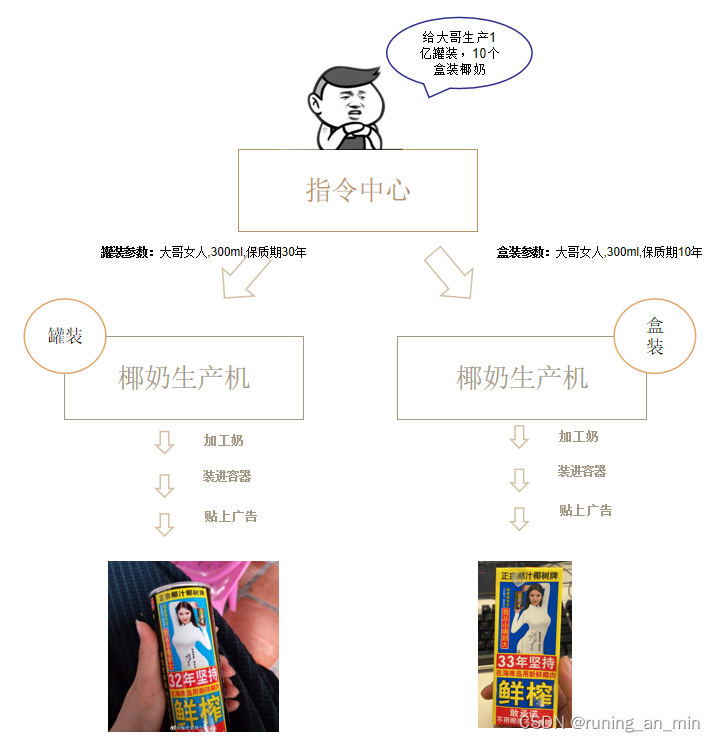
如上图,盒装椰奶和罐装椰奶的生产大致流程, ==>
-
角色分配:
(1)指令发布者,他决定生产每种椰奶的数量
(2)罐装椰奶生产机和盒装椰奶生产机:用来生产成品,也就是我们喝的椰奶
(3)椰奶:用于标识各种类型的椰奶 -
生产流程:
指令发布者 =(参数)> 罐装椰奶机 ——> 罐装椰奶
||
(参数)
||
==> 盒装椰奶机 ——> 盒装椰奶
与工厂模式的比较
我个人理解,建造者模式适用于大场面,而工厂模式适用于小场面。  还是用椰奶来说:
-  椰奶工厂生产椰奶的场景,椰奶对象高度可配置(有很多入参),创造椰奶的设备也会有很多流程,这种场景适合用建造者模式
- 小卖铺买椰奶的场景,椰奶对象简单(只有一个或者两个入参),创造椰奶的设备流程较少,这种场景适合用工厂模式
建造者模式举例
基本上要准备三种对象:
- 产品对象: 对应上面的椰奶
- 生产者:对应上面的盒装生产机以及罐装生产机
- 指挥者:整个流程的发起者,校验指令,给生产者传参,产出产品
"""
@author: hananmin
@time: 2022/4/2 15:26
"""


# 椰奶对象
class CoconutMilk:

    def __init__(self, picture="", volume="", ex_date="", packaging=""):
        # 包装
        self.packaging = packaging
        # 图片
        self.picture = picture
        # 体积
        self.volume = volume
        # 保质期
        self.ex_date = ex_date

    @property
    def drinks(self):
        return f"椰奶: 包装=>{self.packaging} 图片=>{self.picture} 体积=>{self.volume} 保质期=>{self.ex_date}"

# 铁罐生成机器


class CanProducer:

    def __init__(self, nums, picture, ex_date, volume):
        self.nums = nums
        self.packaging = "铁罐"
        self.picture = picture
        self.ex_date = ex_date
        self.volume = volume

    def process_milk(self):
        print(f"生产牛奶 {self.volume}")
        return "200ml"

    def inject_container(self, semi_product):
        print(f"装入容器, 容器是 {self.packaging}")
        semi_product.packaging = self.packaging

    def make_labels(self, semi_product):
        print(f"外包装 保质期{self.ex_date}  图片是 {self.picture} 体积是 {self.volume}")
        semi_product.ex_date = self.ex_date
        semi_product.picture = self.picture
        semi_product.volume = self.volume

    def run(self):
        all_products = []
        print(f"==>{self.packaging} {'*'*10} 开始生产 {'*'*10}")
        for part in range(0, self.nums):
            tmp_pro = CoconutMilk()
            self.process_milk()
            self.inject_container(tmp_pro)
            self.make_labels(tmp_pro)
            all_products.append(tmp_pro)
        print(f"{'*' * 10} 生产结束 {'*' * 10}")
        return all_products

# 盒装生产机器


class BoxProducer:

    def __init__(self, nums, picture, ex_date, volume):
        self.nums = nums
        self.packaging = "纸盒"
        self.picture = picture
        self.ex_date = ex_date
        self.volume = volume

    def process_milk(self):
        print(f"生产牛奶 {self.volume}")
        return "200ml"

    def inject_container(self, semi_product):
        print(f"装入容器, 容器是 {self.packaging}")
        semi_product.packaging = self.packaging

    def make_labels(self, semi_product):
        print(f"外包装 保质期{self.ex_date}  图片是 {self.picture} 体积是 {self.volume}")
        semi_product.ex_date = self.ex_date
        semi_product.picture = self.picture
        semi_product.volume = self.volume

    def run(self):
        all_products = []
        print(f"==>{self.packaging} {'*'*10} 开始生产 {'*'*10}")
        for part in range(0, self.nums):
            tmp_pro = CoconutMilk()
            self.process_milk()
            self.inject_container(tmp_pro)
            self.make_labels(tmp_pro)
            all_products.append(tmp_pro)
        print(f"{'*' * 10} 生产结束 {'*' * 10}")
        return all_products


#  指挥者

class Director:

    def __init__(self, command):
        self.command = command

    # 对命令进行校验
    def verify_command(self):
        if len(self.command) != 2:
            return False
        print(f"指令检验通过")
        return True

    # 生产牛奶
    def product_milk(self):
        if self.verify_command():
            cans = CanProducer(**self.command[0]).run()
            boxes = BoxProducer(**self.command[1]).run()
            print("====>尝一口:")
            print(cans[0].drinks)
            print(boxes[0].drinks)


if __name__ == "__main__":
    command = [
        {"nums": 1, "picture": "大哥女人", "ex_date": "3022年", "volume": "200ml"},
        {"nums": 1, "picture": "大哥女人", "ex_date": "3011年", "volume": "100ml"},
    ]
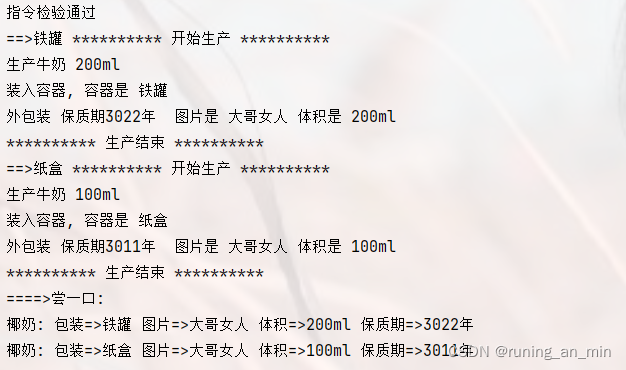
    Director(command).product_milk()
更多推荐

 0
0 0
0- 0


 已为社区贡献4条内容

所有评论(0)