
算法学习(十五)——double DQN
·
收敛并不稳定,有时候第二轮就收敛了,有时候50轮还在打转。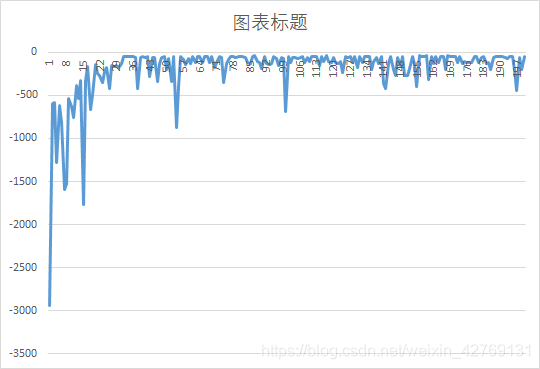
demo:
import torch
import torch.nn as nn
import torch.nn.functional as F
import numpy as np
import gym
import matplotlib.pyplot as plt
import copy
import os
import random
os.environ["KMP_DUPLICATE_LIB_OK"] = "TRUE"

# hyper-parameters
BATCH_SIZE = 128
LR = 0.001  # 注意 这里为0.01的话收敛不好
GAMMA = 0.995
EPISILO = 0.9
MEMORY_CAPACITY = 8000
Q_NETWORK_ITERATION = 100

env = gym.make("MountainCar-v0")
env = env.unwrapped
NUM_ACTIONS = env.action_space.n
NUM_STATES = env.observation_space.shape[0]
ENV_A_SHAPE = 0 if isinstance(env.action_space.sample(), int) else env.action_space.sample.shape

class Net(nn.Module):
    """docstring for Net"""
    def __init__(self):
        super(Net, self).__init__()
        self.fc1 = nn.Linear(NUM_STATES, 50)
        self.fc1.weight.data.normal_(0,0.1)
        self.fc2 = nn.Linear(50,30)
        self.fc2.weight.data.normal_(0,0.1)
        self.out = nn.Linear(30,NUM_ACTIONS)
        self.out.weight.data.normal_(0,0.1)

    def forward(self,x):
        x = self.fc1(x)
        x = F.relu(x)
        x = self.fc2(x)
        x = F.relu(x)
        action_prob = self.out(x)
        return action_prob

class DQN():
    """docstring for DQN"""
    def __init__(self):
        super(DQN, self).__init__()
        self.eval_net, self.target_net = Net().cuda(), Net().cuda()

        self.learn_step_counter = 0
        self.memory_counter = 0
        self.memory = np.zeros((MEMORY_CAPACITY, NUM_STATES * 2 + 2))
        # why the NUM_STATE*2 +2
        # When we store the memory, we put the state, action, reward and next_state in the memory
        # here reward and action is a number, state is a ndarray
        self.optimizer = torch.optim.Adam(self.eval_net.parameters(), lr=LR)
        self.loss_func = nn.MSELoss()

    def choose_action(self, state):
        state = torch.unsqueeze(torch.FloatTensor(state), 0).cuda() # get a 1D array
        if np.random.randn() <= EPISILO:# greedy policy
            action_value = self.eval_net.forward(state)
            action = torch.max(action_value, 1)[1].cpu().data.numpy()
            action = action[0] if ENV_A_SHAPE == 0 else action.reshape(ENV_A_SHAPE)
        else: # random policy
            action = np.random.randint(0,NUM_ACTIONS)
            action = action if ENV_A_SHAPE ==0 else action.reshape(ENV_A_SHAPE)
        return action


    def store_transition(self, state, action, reward, next_state):
        transition = np.hstack((state, [action, reward], next_state))
        index = self.memory_counter % MEMORY_CAPACITY
        self.memory[index, :] = transition
        self.memory_counter += 1


    def learn(self):

        #update the parameters
        if self.learn_step_counter % Q_NETWORK_ITERATION ==0:
            self.target_net.load_state_dict(self.eval_net.state_dict())
        self.learn_step_counter+=1

        #sample batch from memory
        sample_index = np.random.choice(MEMORY_CAPACITY, BATCH_SIZE)
        batch_memory = self.memory[sample_index, :]
        batch_state = torch.FloatTensor(batch_memory[:, :NUM_STATES]).cuda()
        batch_action = torch.LongTensor(batch_memory[:, NUM_STATES:NUM_STATES+1].astype(int)).cuda()
        batch_reward = torch.FloatTensor(batch_memory[:, NUM_STATES+1:NUM_STATES+2]).cuda()
        batch_next_state = torch.FloatTensor(batch_memory[:,-NUM_STATES:]).cuda()

        #q_eval
        actions_value = self.eval_net.forward(batch_next_state)
        next_action = torch.unsqueeze(torch.max(actions_value, 1)[1], 1)
        eval_q = self.eval_net.forward(batch_state).gather(1, batch_action)
        next_q = self.target_net.forward(batch_next_state).gather(1, next_action)
        target_q = batch_reward + GAMMA * next_q
        loss = self.loss_func(eval_q, target_q)


        self.optimizer.zero_grad()
        loss.backward()
        self.optimizer.step()


def main():

    dqn = DQN()
    episodes = 400
    print("Collecting Experience....")
    for i in range(episodes):
        state = env.reset()
        ep_reward = 0
        while True:
            env.render()
            action = dqn.choose_action(state)
            next_state, reward, done, info = env.step(action)
            dqn.store_transition(state, action, reward, next_state)
            ep_reward += reward

            if dqn.memory_counter >= MEMORY_CAPACITY:
                dqn.learn()
                # if done:
                #     print("episode: {} , the episode reward is ,{}".format(i, round(ep_reward, 3)))
            if done:
                print("episode: {} , the episode reward is ,{}".format(i, round(ep_reward, 3)))
                # print(dqn.memory_counter)
                break
            state = next_state


if __name__ == '__main__':
    main()
使用的环境:
"""
http://incompleteideas.net/sutton/MountainCar/MountainCar1.cp
permalink: https://perma.cc/6Z2N-PFWC
"""
import math

import numpy as np

import gym
from gym import spaces
from gym.utils import seeding


class MountainCarEnv(gym.Env):
    """
    Description:
        The agent (a car) is started at the bottom of a valley. For any given
        state the agent may choose to accelerate to the left, right or cease
        any acceleration.

    Source:
        The environment appeared first in Andrew Moore's PhD Thesis (1990).

    Observation:
        Type: Box(2)
        Num    Observation               Min            Max
        0      Car Position              -1.2           0.6
        1      Car Velocity              -0.07          0.07

    Actions:
        Type: Discrete(3)
        Num    Action
        0      Accelerate to the Left
        1      Don't accelerate
        2      Accelerate to the Right

        Note: This does not affect the amount of velocity affected by the
        gravitational pull acting on the car.

    Reward:
         Reward of 0 is awarded if the agent reached the flag (position = 0.5)
         on top of the mountain.
         Reward of -1 is awarded if the position of the agent is less than 0.5.

    Starting State:
         The position of the car is assigned a uniform random value in
         [-0.6 , -0.4].
         The starting velocity of the car is always assigned to 0.

    Episode Termination:
         The car position is more than 0.5
         Episode length is greater than 200
    """

    metadata = {
        'render.modes': ['human', 'rgb_array'],
        'video.frames_per_second': 30
    }

    def __init__(self, goal_velocity=0):
        self.min_position = -1.2
        self.max_position = 0.6
        self.max_speed = 0.07
        self.goal_position = 0.5
        self.goal_velocity = goal_velocity

        self.force = 0.001
        self.gravity = 0.0025

        self.low = np.array(
            [self.min_position, -self.max_speed], dtype=np.float32
        )
        self.high = np.array(
            [self.max_position, self.max_speed], dtype=np.float32
        )

        self.viewer = None

        self.action_space = spaces.Discrete(3)
        self.observation_space = spaces.Box(
            self.low, self.high, dtype=np.float32
        )

        self.seed()

    def seed(self, seed=None):
        self.np_random, seed = seeding.np_random(seed)
        return [seed]

    def step(self, action):
        assert self.action_space.contains(action), "%r (%s) invalid" % (action, type(action))

        position, velocity = self.state
        velocity += (action - 1) * self.force + math.cos(3 * position) * (-self.gravity)
        velocity = np.clip(velocity, -self.max_speed, self.max_speed)
        position += velocity
        position = np.clip(position, self.min_position, self.max_position)
        if (position == self.min_position and velocity < 0):
            velocity = 0

        done = bool(
            position >= self.goal_position and velocity >= self.goal_velocity
        )

        reward = 0
        if done:
            reward = 100.0
        reward -= 1

        self.state = (position, velocity)
        return np.array(self.state), reward, done, {}

    def reset(self):
        self.state = np.array([self.np_random.uniform(low=-0.6, high=-0.4), 0])
        return np.array(self.state)

    def _height(self, xs):
        return np.sin(3 * xs) * .45 + .55

    def render(self, mode='human'):
        screen_width = 600
        screen_height = 400

        world_width = self.max_position - self.min_position
        scale = screen_width / world_width
        carwidth = 40
        carheight = 20

        if self.viewer is None:
            from gym.envs.classic_control import rendering
            self.viewer = rendering.Viewer(screen_width, screen_height)
            xs = np.linspace(self.min_position, self.max_position, 100)
            ys = self._height(xs)
            xys = list(zip((xs - self.min_position) * scale, ys * scale))

            self.track = rendering.make_polyline(xys)
            self.track.set_linewidth(4)
            self.viewer.add_geom(self.track)

            clearance = 10

            l, r, t, b = -carwidth / 2, carwidth / 2, carheight, 0
            car = rendering.FilledPolygon([(l, b), (l, t), (r, t), (r, b)])
            car.add_attr(rendering.Transform(translation=(0, clearance)))
            self.cartrans = rendering.Transform()
            car.add_attr(self.cartrans)
            self.viewer.add_geom(car)
            frontwheel = rendering.make_circle(carheight / 2.5)
            frontwheel.set_color(.5, .5, .5)
            frontwheel.add_attr(
                rendering.Transform(translation=(carwidth / 4, clearance))
            )
            frontwheel.add_attr(self.cartrans)
            self.viewer.add_geom(frontwheel)
            backwheel = rendering.make_circle(carheight / 2.5)
            backwheel.add_attr(
                rendering.Transform(translation=(-carwidth / 4, clearance))
            )
            backwheel.add_attr(self.cartrans)
            backwheel.set_color(.5, .5, .5)
            self.viewer.add_geom(backwheel)
            flagx = (self.goal_position-self.min_position) * scale
            flagy1 = self._height(self.goal_position) * scale
            flagy2 = flagy1 + 50
            flagpole = rendering.Line((flagx, flagy1), (flagx, flagy2))
            self.viewer.add_geom(flagpole)
            flag = rendering.FilledPolygon(
                [(flagx, flagy2), (flagx, flagy2 - 10), (flagx + 25, flagy2 - 5)]
            )
            flag.set_color(.8, .8, 0)
            self.viewer.add_geom(flag)

        pos = self.state[0]
        self.cartrans.set_translation(
            (pos-self.min_position) * scale, self._height(pos) * scale
        )
        self.cartrans.set_rotation(math.cos(3 * pos))

        return self.viewer.render(return_rgb_array=mode == 'rgb_array')

    def get_keys_to_action(self):
        # Control with left and right arrow keys.
        return {(): 1, (276,): 0, (275,): 2, (275, 276): 1}

    def close(self):
        if self.viewer:
            self.viewer.close()
            self.viewer = None
更多推荐
 0
0 0
0- 0


 已为社区贡献8条内容

所有评论(0)