
混合算法(SA+TS)解决TSP问题——lua实现(Microcity)
模拟退火算法和禁忌搜索结合(SA+TS)混合算法解决TSP问题——lua实现(Microcity)
本文从TSLIB上获取实际城市坐标,写出单独使用模拟退火(SA),模拟退火和禁忌搜索结合(SA+TS)的算法流程图和各自代码结果,最后与CPLEX精确解进行比较,得出混合(SA+TS)算法在求解效率和质量上的优越性。
当时为了赶现代优化技术大作业做的并不是很完善,大家可以批评指正。MicroCity软件是我导师自己编写的软件,集成了包括GIS、DES(离散事件仿真)、3D、Optimizer、Network、PLC control等等功能于一体。下载链接:https://pan.baidu.com/s/1S7a1al1r48pCw3Zr3g0GCg 提取码:o1at
首先,在TSPLIB上获取到的burma14.tsp.gz文件,其中包含十四个城市的坐标:

混合算法流程图(Microsoft Viso绘制):

单纯使用模拟退火的代码(使用lua编写,MicroCity编译):
--Author:sts
--Date:2020.12.10
function Tsp_SA()               --求解TSP-burma14问题
    local T                     --当前温度
    local T_start = 5000.0      --初始温度
    local T_end = 0.00000008    --结束温度
    local q = 0.98              --退火系数
    local L = 1000              --每个温度最大迭代次数
    local N = 14                --城市个数
    local result = {}           --路径数组
    local count = 0             --迭代次数
    local time0 = os.clock()

    local p = {{16,96},{16,94},{20,92},{22,93},{25,97},{22,96},{20,97},{17,96},{16,97},{14,98},{16,97},{21,95},{19,97},{20,94}}         --缅甸14座城市城市坐标

    function ini()          --初始化
        for i = 1, N do
            result[i] = i   --顺序生成解空间
        end
    end

    function distance(p1,p2)  --求两点间距离
        local distance = math.sqrt(math.pow(p1[1]-p2[1],2)+math.pow(p1[2]-p2[2],2))
        return distance
    end

    function path_len(result)  --路径总长度
        local sum = 0
        for i = 1, N-1 do
            sum = sum + distance(p[result[i]],p[result[i+1]])
        end
        sum = sum + distance(p[result[14]],p[result[1]])
        return sum
    end

    function create()  --生成新的解空间
        local new = {}
        for i = 1, N do             --把旧解空间的每个值赋给新解空间
            new[i] = result[i]
        end
        random = CreateRandEng(math.random(0,100000000),"uniform_int",1,N) --生成均匀分布1-14整数随机数,随机数种子也为随机数,以此保证每次随机数生成不同,且p1,p2不同
        p1 = GetNextRandom(random)
        p2 = GetNextRandom(random)
        new[p1], new[p2] = result[p2], result[p1]
        return new
    end

    function main()  --主函数
        ini()
        T = T_start
        while T > T_end do
            for i = 1, L do
                new_result = create()               --产生新的解空间
                local path1 = path_len(result)
                local path2 = path_len(new_result)
                local dE = path1 - path2
                if dE > 0 then                      --Metropolis准则
                    r = math.random(0,1)            --接受新解概率下界
                    if math.exp(-dE/T) > r then     --高温状态下,可以接受能量差值较大的新状态;低温状态下,则只能接受能量差值较小的新状态
                        result = new_result         --接受新解
                    end
                end
            end
            T = T * q
            count = count + 1
        end
        local time1 = os.clock()
        print("共降温:", count,"次");
        print("旅行商路径为:", table.concat(result,"->"),"->",result[1])
        print("总长度为:", path_len(result))
        print("计算所用时间为:", time1 - time0, "s")
    end
    main()
end
Tsp_SA()
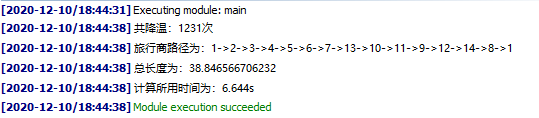
利用Microcity编译,结果为38.85,旅行商路径为:1->2->3->4->5->6->7->13->10->11->9->12->14->8->1, 计算所用时间为:6.644s
模拟退火与禁忌搜索结合使用的代码(使用lua编写,MicroCity编译):
--Author:sts
--Date:2020.12.10
function Tsp_SA_TS()            --求解TSP-burma14问题
    local T                     --当前温度
    local T_start = 5000.0      --初始温度
    local T_end = 0.00000008    --结束温度
    local q = 0.98              --退火系数
    local L = 1000              --每个温度最大迭代次数
    local N = 14                --城市个数
    local result = {}           --路径数组
    local count = 0             --迭代次数
    local tabu = {}             --初始化禁忌表
    local time0 = os.clock()    --初始操作系统时间

    local p = {{16,96},{16,94},{20,92},{22,93},{25,97},{22,96},{20,97},{17,96},{16,97},{14,98},{16,97},{21,95},{19,97},{20,94}}         --缅甸14座城市城市坐标

    function ini()          --初始化
        for i = 1, N do
            result[i] = i   --顺序生成解空间
        end
    end

    function distance(p1,p2)  --求两点间距离
        local distance = math.sqrt(math.pow(p1[1]-p2[1],2)+math.pow(p1[2]-p2[2],2))
        return distance
    end

    function path_len(result)  --路径总长度
        local sum = 0
        for i = 1, N-1 do
            sum = sum + distance(p[result[i]],p[result[i+1]])
        end
        sum = sum + distance(p[result[14]],p[result[1]])
        return sum
    end

    function create()  --生成新的解空间
        local new = {}
        for i = 1, N do             --把旧解空间的每个值赋给新解空间
            new[i] = result[i]
        end
        random = CreateRandEng(math.random(0,100000),"uniform_int",1,N) --生成均匀分布1-14整数随机数,随机数种子也为随机数,以此保证每次随机数生成不同,且p1,p2不同
        p1 = GetNextRandom(random)
        p2 = GetNextRandom(random)
        new[p1], new[p2] = result[p2], result[p1]                       --随机交换序列中两个城市的排序,2U法则
        return new
    end

    function main()  --主函数
        ini()
        T = T_start
        while T > T_end do
            for i = 1, L do
                new_result = create()               --产生新的解空间
                if #tabu <= 100 then                --更新禁忌表
                    table.insert(tabu,path_len(new_result))   --初始化禁忌表
                else
                    local max = 0
                    local j = 0
                    for k = 1, 100 do
                        if tabu[k] > max then
                            max = tabu[k]
                            j = k
                        end
                    end
                    if path_len(new_result) < max then      --更新禁忌表,新解代替最差解
                        table.insert(tabu,j,path_len(new_result))
                    end
                end
                local path1 = path_len(result)
                local path2 = path_len(new_result)
                local dE = path1 - path2
                local min = 999
                local j = 0
                for k = 1, 100 do               --与禁忌表的最小值比较
                    if tabu[k] and tabu[k] < min then
                        min = tabu[k]
                        j = i
                    end
                end
                if math.exp((min-path2)/T) > math.random(0,1) then  --高温状态下,可以接受比禁忌表最小值大的值
                    if dE > 0 then                      --Metropolis准则
                        r = math.random(0,1)            --接受新解概率下界
                        if math.exp(-dE/T) > r and math.exp((min-path2)/T) > r then     --高温状态下,可以接受能量差值较大的新状态;低温状态下,则只能接受能量差值较小的新状态
                            result = new_result         --接受新解
                        end
                    end
                else
                    break
                end
            end
            T = T * q
            count = count + 1
        end
        local time1 = os.clock()
        print("共降温:", count,"次");
        print("旅行商路径为:", table.concat(result,"->"),"->",result[1])
        print("总长度为:", path_len(result))
        print("计算所用时间为:", time1 - time0, "s")
    end
    main()
end
Tsp_SA_TS()
利用Microcity编译,结果为32.23,旅行商路径为:13->7->6->5->4->12->14->3->2->1->10->9->11->8->13, 计算所用时间为:0.016s,不难看出,加入了禁忌搜索,算法无论在解的质量和求解效率上都有提升。

利用CPLEX求精确解,代码和结果如下,最优解为28,具体步骤与代码如下
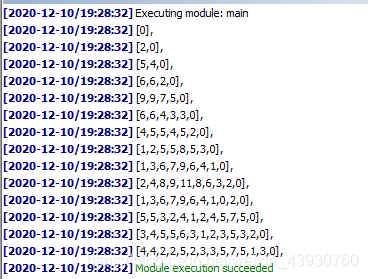
lua建立运输距离矩阵代码,生成后导入CPLEX的.DAT文件中
function Dis_Matrix()
    local p = {{16,96},{16,94},{20,92},{22,93},{25,97},{22,96},{20,97},{17,96},{16,97},{14,98},{16,97},{21,95},{19,97},{20,94}}
    local dis = {}
    function distance(p1,p2)  --求两点间距离
        local distance = math.sqrt(math.pow(p1[1]-p2[1],2)+math.pow(p1[2]-p2[2],2))
        distance = math.floor(distance)
        return distance
    end
    for i = 1, #p do
        dis[i] = {}
        for j = 1, i do
            dis[i][j] = distance(p[i],p[j])
        end
        print("[",table.concat(dis[i],",",dis[i][j]),"],")
    end
end
Dis_Matrix()
结果为
CPLEX的.MOD文件:
/*********************************************
 * OPL 12.6.3.0 Model
 * Author: sts
 * Creation Date: 2020-12-8 at 下午6:45:23
 *********************************************/
int CityNum = ...;//the number of city
range City =0..CityNum-1;
//range SNode =2..CityNum-1;
float distance[City][City]=...;//the distance between city A and city B
dvar boolean visitCity[City][City];//City A to city B or not
{int} nodes ={i|i in City};
range r=1..-2+ftoi(pow(2,card(nodes)));
{int} nodes2[k in r]={i|i in nodes :((k div(ftoi(pow(2,(ord(nodes,i)))))mod 2)==1)};
execute{
	for(var c1 in City)
		for(var c2 in City)
		if(c1<c2)distance[c1][c2]=distance[c2][c1];
}
minimize
  sum(c1 in City)
    sum(c2 in City)
      distance[c1][c2]*visitCity[c1][c2];

subject to{
	forall(c1 in City)
	  sum(c2 in City)
	    visitCity[c1][c2]==1;
	forall(c2 in City)
	  sum(c1 in City)
	    visitCity[c1][c2]==1;
	forall(c1 in City)
	  visitCity[c1][c1]==0;
	forall(s in r){
		sum(c1 in nodes2[s])
		  sum(c2 in nodes2[s])
		    visitCity[c1][c2]<=card(nodes2[s])-1;
    }
}
CPLEX的.DAT文件(距离矩阵,使用lua程序生成后导入):
/*********************************************
 * OPL 12.6.3.0 Data
 * Author: sts
 * Creation Date: 2020-12-8 at 下午6:45:23
 *********************************************/
CityNum=14;
distance=[
[0],
[2,0],
[5,4,0],
[6,6,2,0],
[9,9,7,5,0],
[6,6,4,3,3,0],
[4,5,5,4,5,2,0],
[1,2,5,5,8,5,3,0],
[1,3,6,7,9,6,4,1,0],
[2,4,8,9,11,8,6,3,2,0],
[1,3,6,7,9,6,4,1,0,2,0],
[5,5,3,2,4,1,2,4,5,7,5,0],
[3,4,5,5,6,3,1,2,3,5,3,2,0],
[4,4,2,2,5,2,3,3,5,7,5,1,3,0]];
结果,最优解为28 :
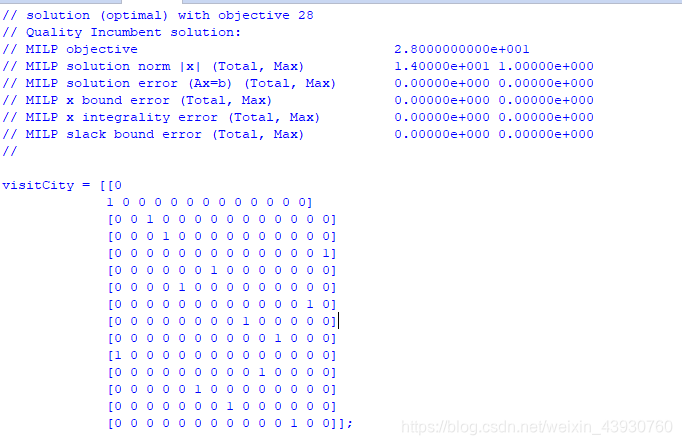
所以,模拟退火法与禁忌搜索法结合性能较好,与精确解只差了4误差。
更多推荐



 1
1 0
0- 0


 已为社区贡献1条内容

所有评论(0)