
pytorch简单实现yolo v1
yolo v1 原理简析
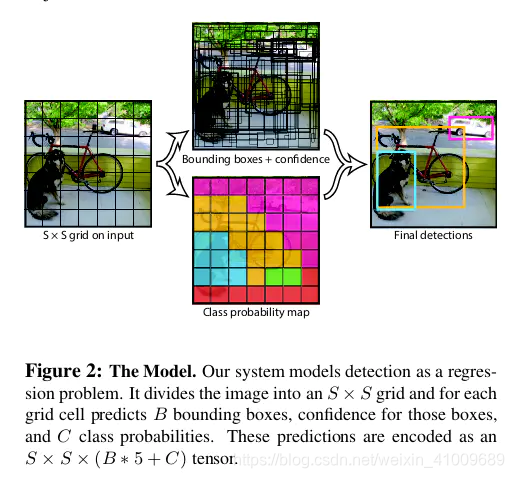
yolo v1的原理相较于其他的一些目标检测算法稍微没那么复杂,Yolo采用一个单独的CNN模型实现end-to-end的目标检测模型。
检测框架
整个框架把输入图片分成S×S个grid,然后每个格子预测两个bbox,每个bbox包含五个预测参数:x, y, w, h, c。前四个参数都是归一化之后的,其中c代表置信度,表示预测的这个框属于哪一个物体。另外每个格子都预测20个假定类别的概率,网络的最后输出为S×S×30(52+20),论文中将整个图品分为77,所以S=7。
其中c(置信度)的计算公式为

每个bbox都有一个对应的confidence score,如果当前的grid cell中不包含物体的话,这个confidence就应该为0,如果有的话,这个confidence score就等于预测的box与ground truth的iou值。那么如何判断一个grid cell 中是否包含物体呢??作者是这么做的:如果一个object的ground truth的中心点坐标落入一个grid cell中,那么这个grid cell就包含这个object,这个object的预测就由这个grid cell负责(也就是说每一个grid只能预测一个物体,那么对于分布密集的物体,就极有可能造成漏检,因为密集的物体可能会有多个物体的中心落在同一个grid之中。)
网络结构
在模型结构方面基本继承了GoogleNet的结构如下:
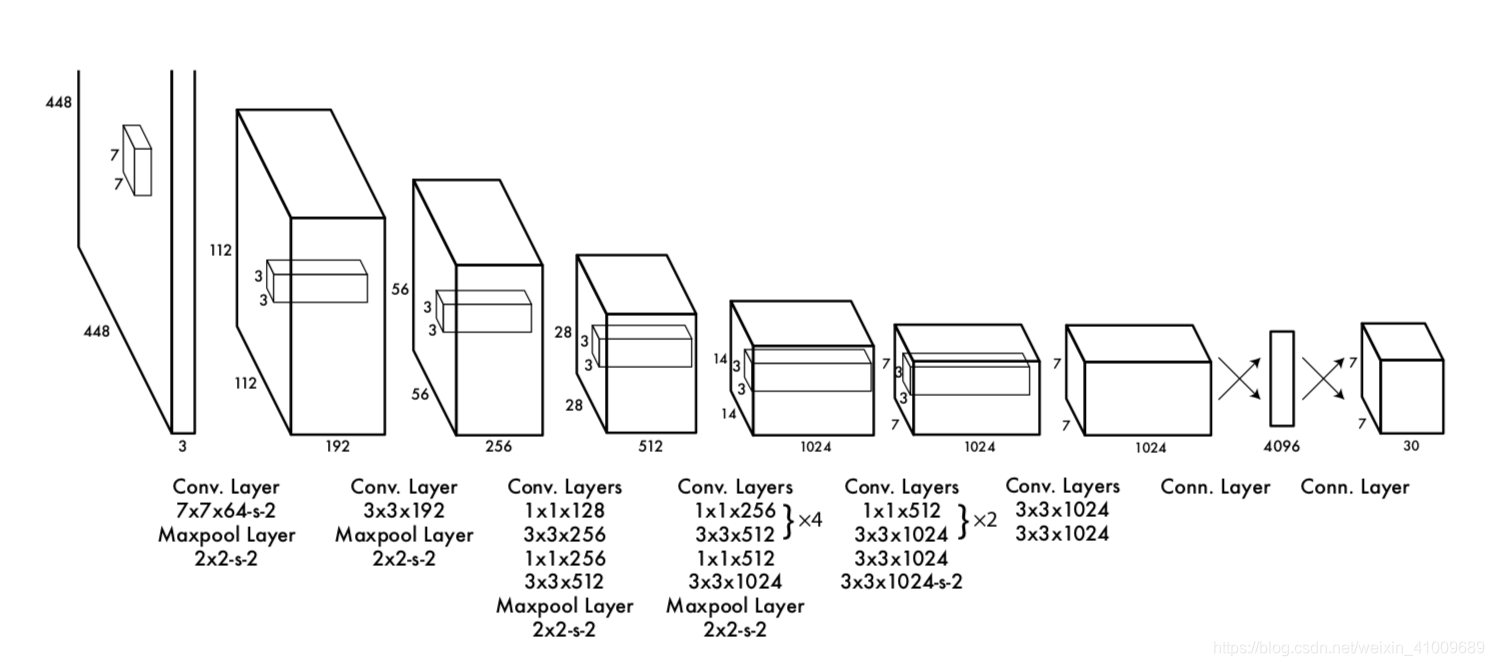
为了方便使用pytorch的预训练模型,采用了resnet50。
import torch.nn as nn
import math
import torch.utils.model_zoo as model_zoo
import torch.nn.functional as F
import torch
import torchvision.models as models
from torch.autograd import Variable

__all__ = ['ResNet', 'resnet50']


model_urls = {'resnet50': 'https://download.pytorch.org/models/resnet50-19c8e357.pth'}


def conv3x3(in_planes, out_planes, stride=1):
    "3x3 convolution with padding"
    return nn.Conv2d(in_planes, out_planes, kernel_size=3, stride=stride,
                     padding=1, bias=False)


class BasicBlock(nn.Module):
    expansion = 1

    def __init__(self, inplanes, planes, stride=1, downsample=None):
        super(BasicBlock, self).__init__()
        self.conv1 = conv3x3(inplanes, planes, stride)
        self.bn1 = nn.BatchNorm2d(planes)
        self.relu = nn.ReLU(inplace=True)
        self.conv2 = conv3x3(planes, planes)
        self.bn2 = nn.BatchNorm2d(planes)
        self.downsample = downsample
        self.stride = stride

    def forward(self, x):
        residual = x

        out = self.conv1(x)
        out = self.bn1(out)
        out = self.relu(out)

        out = self.conv2(out)
        out = self.bn2(out)

        if self.downsample is not None:
            residual = self.downsample(x)

        out += residual
        out = self.relu(out)

        return out


class Bottleneck(nn.Module):
    expansion = 4

    def __init__(self, inplanes, planes, stride=1, downsample=None):
        super(Bottleneck, self).__init__()
        self.conv1 = nn.Conv2d(inplanes, planes, kernel_size=1, bias=False)
        self.bn1 = nn.BatchNorm2d(planes)
        self.conv2 = nn.Conv2d(planes, planes, kernel_size=3, stride=stride,
                               padding=1, bias=False)
        self.bn2 = nn.BatchNorm2d(planes)
        self.conv3 = nn.Conv2d(planes, planes * 4, kernel_size=1, bias=False)
        self.bn3 = nn.BatchNorm2d(planes * 4)
        self.relu = nn.ReLU(inplace=True)
        self.downsample = downsample
        self.stride = stride

    def forward(self, x):
        residual = x

        out = self.conv1(x)
        out = self.bn1(out)
        out = self.relu(out)

        out = self.conv2(out)
        out = self.bn2(out)
        out = self.relu(out)

        out = self.conv3(out)
        out = self.bn3(out)

        if self.downsample is not None:
            residual = self.downsample(x)

        out += residual
        out = self.relu(out)

        return out


class detnet_bottleneck(nn.Module):
    # no expansion
    # dilation = 2
    # type B use 1x1 conv
    expansion = 1

    def __init__(self, in_planes, planes, stride=1, block_type='A'):
        super(detnet_bottleneck, self).__init__()
        self.conv1 = nn.Conv2d(in_planes, planes, kernel_size=1, bias=False)
        self.bn1 = nn.BatchNorm2d(planes)
        self.conv2 = nn.Conv2d(
            planes,
            planes,
            kernel_size=3,
            stride=stride,
            padding=2,
            bias=False,
            dilation=2)
        self.bn2 = nn.BatchNorm2d(planes)
        self.conv3 = nn.Conv2d(
            planes,
            self.expansion *
            planes,
            kernel_size=1,
            bias=False)
        self.bn3 = nn.BatchNorm2d(self.expansion * planes)

        self.downsample = nn.Sequential()
        if stride != 1 or in_planes != self.expansion * planes or block_type == 'B':
            self.downsample = nn.Sequential(
                nn.Conv2d(
                    in_planes,
                    self.expansion *
                    planes,
                    kernel_size=1,
                    stride=stride,
                    bias=False),
                nn.BatchNorm2d(
                    self.expansion *
                    planes))

    def forward(self, x):
        out = F.relu(self.bn1(self.conv1(x)))
        out = F.relu(self.bn2(self.conv2(out)))
        out = self.bn3(self.conv3(out))
        out += self.downsample(x)
        out = F.relu(out)
        return out


class ResNet(nn.Module):

    def __init__(self, block, layers, num_classes=1470):
        self.inplanes = 64
        super(ResNet, self).__init__()
        self.conv1 = nn.Conv2d(3, 64, kernel_size=7, stride=2, padding=3,
                               bias=False)
        self.bn1 = nn.BatchNorm2d(64)
        self.relu = nn.ReLU(inplace=True)
        self.maxpool = nn.MaxPool2d(kernel_size=3, stride=2, padding=1)
        self.layer1 = self._make_layer(block, 64, layers[0])
        self.layer2 = self._make_layer(block, 128, layers[1], stride=2)
        self.layer3 = self._make_layer(block, 256, layers[2], stride=2)
        self.layer4 = self._make_layer(block, 512, layers[3], stride=2)
        # self.layer5 = self._make_layer(block, 512, layers[3], stride=2)
        self.layer5 = self._make_detnet_layer(in_channels=2048)
        self.avgpool = nn.AvgPool2d(2)  # fit 448 input size
        # self.fc = nn.Linear(512 * block.expansion, num_classes)
        self.conv_end = nn.Conv2d(
            256,
            30,
            kernel_size=3,
            stride=1,
            padding=1,
            bias=False)
        self.bn_end = nn.BatchNorm2d(30)
        for m in self.modules():
            if isinstance(m, nn.Conv2d):
                n = m.kernel_size[0] * m.kernel_size[1] * m.out_channels
                m.weight.data.normal_(0, math.sqrt(2. / n))
            elif isinstance(m, nn.BatchNorm2d):
                m.weight.data.fill_(1)
                m.bias.data.zero_()

    def _make_layer(self, block, planes, blocks, stride=1):
        downsample = None
        if stride != 1 or self.inplanes != planes * block.expansion:
            downsample = nn.Sequential(
                nn.Conv2d(self.inplanes, planes * block.expansion,
                          kernel_size=1, stride=stride, bias=False),
                nn.BatchNorm2d(planes * block.expansion),
            )

        layers = []
        layers.append(block(self.inplanes, planes, stride, downsample))
        self.inplanes = planes * block.expansion
        for i in range(1, blocks):
            layers.append(block(self.inplanes, planes))

        return nn.Sequential(*layers)

    def _make_detnet_layer(self, in_channels):
        layers = []
        layers.append(
            detnet_bottleneck(
                in_planes=in_channels,
                planes=256,
                block_type='B'))
        layers.append(
            detnet_bottleneck(
                in_planes=256,
                planes=256,
                block_type='A'))
        layers.append(
            detnet_bottleneck(
                in_planes=256,
                planes=256,
                block_type='A'))
        return nn.Sequential(*layers)

    def forward(self, x):
        x = self.conv1(x)
        x = self.bn1(x)
        x = self.relu(x)
        x = self.maxpool(x)

        x = self.layer1(x)
        x = self.layer2(x)
        x = self.layer3(x)
        x = self.layer4(x)
        x = self.layer5(x)
        x = self.avgpool(x)
        # x = x.view(x.size(0), -1)
        # x = self.fc(x)
        x = self.conv_end(x)
        x = self.bn_end(x)
        x = torch.sigmoid(x)
        # x = x.view(-1,7,7,30)
        x = x.permute(0, 2, 3, 1)  # (-1,7,7,30)

        return x


def resnet50(pretrained=False):
    """Constructs a ResNet-50 model.

    Args:
        pretrained (bool): If True, returns a model pre-trained on ImageNet
    """
    model = ResNet(Bottleneck, [3, 4, 6, 3])
    if pretrained:
        model.load_state_dict(model_zoo.load_url(model_urls['resnet50']))
    return model
由图可以看出最后的输出每个grid有30维,与之前讨论的相对应,前八维是Box的坐标,2维是box的confidence,还有20个类别概率,网络坐标的x,y用对应于网格的offset归一化值0到1之间,w,h用图像的width和height归一化到0-1之间。
损失函数
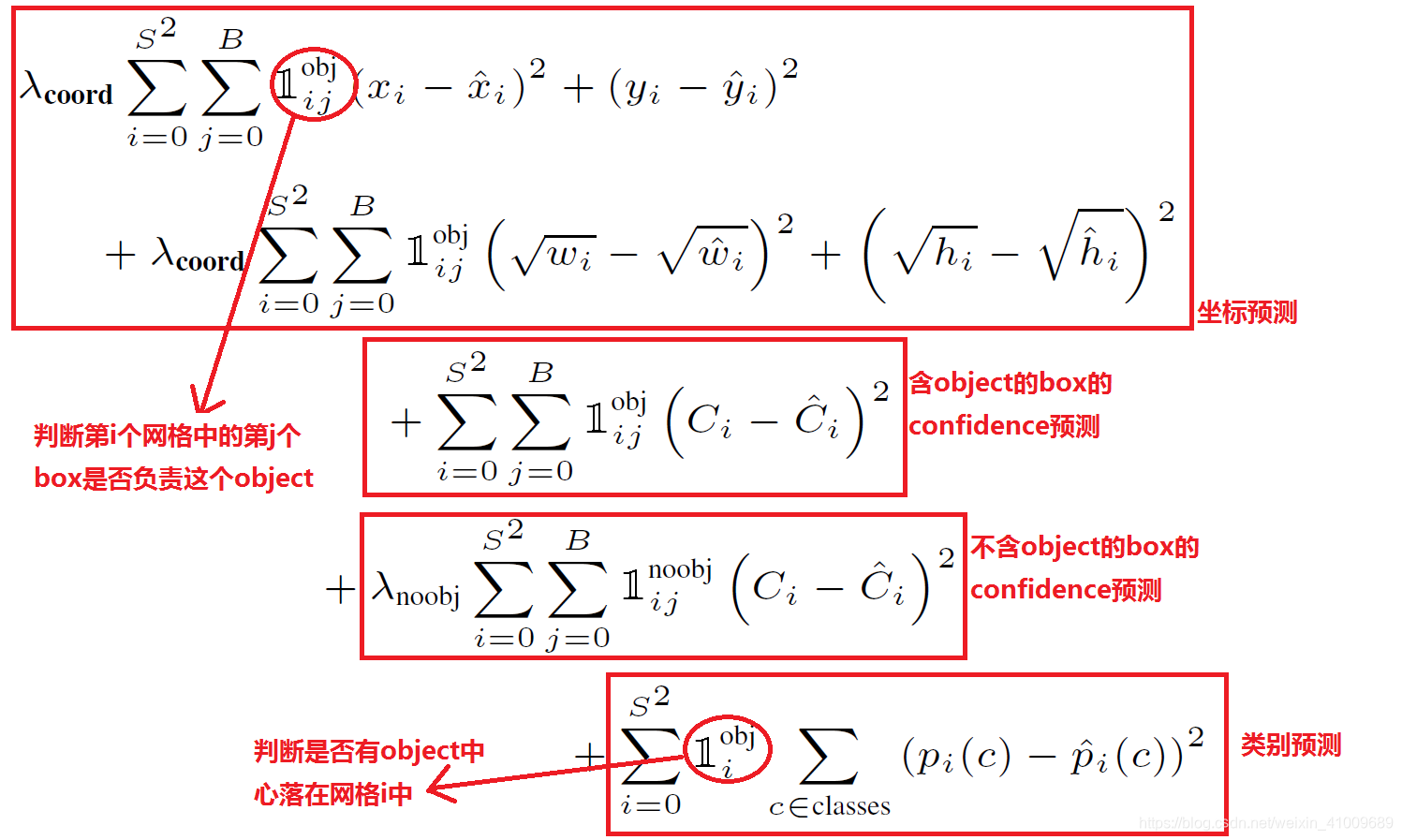
在一个网络的实现中,最主要的就是怎么设计损失函数,为了让这三个方面得到很好的平衡,作者简单粗暴的全部采用了sum-squared error loss来做这件事。
但是这种做法存在以下几个问题:
第一,8维的localization error和20维的classification error同等重要显然是不合理的;
第二,如果一个网格中没有物体(一幅图中这种网格很多),那么就会将这些网格中的box的confidence push到0,相较于较少的的有物体的网格,这会导致网络不稳定甚至发散。
作者提出以下几种办法:
-
更重视8维的坐标预测,给这些损失前面赋予更大的Loss weight,记为l_coord,在pascaal VOC训练中取5
-
对于没有物体的box的confidense loss,赋予小的loss weight,记为l_noobj,在pascaal VOC训练中取0.5
-
有object的box的confidence loss和类别的loss的loss weight正常取1。
-
对不同大小的box预测中,相比于大box预测偏一点,小box预测偏一点肯定更不能被忍受的。而sum-square error loss中对同样的偏移loss是一样。
为了缓和这个问题,作者用了一个比较取巧的办法,就是将box的width和height取平方根代替原本的height和width。这个参考下面的图很容易理解,小box的横轴值较小,发生偏移时,反应到y轴上相比大box要大。 -
一个网格预测多个box,希望的是每个box predictor专门负责预测某个object。具体做法就是看当前预测的box与ground truth box中哪个IoU大,就负责哪个。这种做法称作box predictor的specialization。
-
最后整个的损失函数如下所示
import torch
import torch.nn as nn
import torch.nn.functional as F


class yoloLoss(nn.Module):
    def __init__(self, S, B, l_coord, l_noobj):  # 为了更重视8维的坐标预测,给这些算是前面赋予更大的loss weight
        # 对于有物体的记为λcoord,在pascal VOC训练中取5,对于没有object的bbox的confidence loss,前面赋予更小的loss weight 记为 λnoobj
        # 在pascal VOC训练中取0.5
        # 有object的bbox的confidence loss (上图红色框) 和类别的loss (上图紫色框)的loss weight正常取1

        super(yoloLoss, self).__init__()
        self.S = S
        self.B = B
        self.l_coord = l_coord
        self.l_noobj = l_noobj

    def compute_iou(self, box1, box2):
    # iou的作用是,当一个物体有多个框时,选一个相比ground truth最大的执行度的为物体的预测,然后将剩下的框降序排列,如果后面的框中有与这个框的iou大于一定的阈值时则将这个框舍去(这样就可以抑制一个物体有多个框的出现了),目标检测算法中都会用到这种思想。
        '''Compute the intersection over union of two set of boxes, each box is [x1,y1,x2,y2].
        Args:
          box1: (tensor) bounding boxes, sized [N,4].
          box2: (tensor) bounding boxes, sized [M,4].
        Return:
          (tensor) iou, sized [N,M].
        '''
        N = box1.size(0)
        M = box2.size(0)

        lt = torch.max(
            # [N,2] -> [N,1,2] -> [N,M,2]
            box1[:, :2].unsqueeze(1).expand(N, M, 2),
            # [M,2] -> [1,M,2] -> [N,M,2]
            box2[:, :2].unsqueeze(0).expand(N, M, 2),
        )

        rb = torch.min(
            # [N,2] -> [N,1,2] -> [N,M,2]
            box1[:, 2:].unsqueeze(1).expand(N, M, 2),
            # [M,2] -> [1,M,2] -> [N,M,2]
            box2[:, 2:].unsqueeze(0).expand(N, M, 2),
        )

        wh = rb - lt  # [N,M,2]
        wh[wh < 0] = 0  # clip at 0
        inter = wh[:, :, 0] * wh[:, :, 1]  # [N,M]

        area1 = (box1[:, 2] - box1[:, 0]) * (box1[:, 3] - box1[:, 1])  # [N,]
        area2 = (box2[:, 2] - box2[:, 0]) * (box2[:, 3] - box2[:, 1])  # [M,]
        area1 = area1.unsqueeze(1).expand_as(inter)  # [N,] -> [N,1] -> [N,M]
        area2 = area2.unsqueeze(0).expand_as(inter)  # [M,] -> [1,M] -> [N,M]

        iou = inter / (area1 + area2 - inter)
        return iou

    def forward(self, pred_tensor, target_tensor):
        '''
        pred_tensor: (tensor) size(batchsize,S,S,Bx5+20=30) [x,y,w,h,c]---预测对应的格式
        target_tensor: (tensor) size(batchsize,S,S,30) --- 标签的准确格式
        '''
        N = pred_tensor.size()[0]
        coo_mask = target_tensor[:, :, :, 4] > 0   # 具有目标标签的索引

        noo_mask = target_tensor[:, :, :, 4] == 0  # 不具有目标的标签索引
        # 得到含物体的坐标等信息
        coo_mask = coo_mask.unsqueeze(-1).expand_as(target_tensor)
        # 得到不含物体的坐标等信息
        noo_mask = noo_mask.unsqueeze(-1).expand_as(target_tensor)

        coo_pred = pred_tensor[coo_mask].view(-1, 30)
        box_pred = coo_pred[:, :10].contiguous(
        ).view(-1, 5)  # box[x1,y1,w1,h1,c1]
        class_pred = coo_pred[:, 10:]  # [x2,y2,w2,h2,c2]

        coo_target = target_tensor[coo_mask].view(-1, 30)
        box_target = coo_target[:, :10].contiguous().view(-1, 5)
        class_target = coo_target[:, 10:]

        # compute not contain obj loss
        noo_pred = pred_tensor[noo_mask].view(-1, 30)
        noo_target = target_tensor[noo_mask].view(-1, 30)
        noo_pred_mask = torch.cuda.ByteTensor(noo_pred.size())
        noo_pred_mask.zero_()
        noo_pred_mask[:, 4] = 1
        noo_pred_mask[:, 9] = 1
        noo_pred_c = noo_pred[noo_pred_mask]  # noo pred只需要计算 c 的损失 size[-1,2]
        noo_target_c = noo_target[noo_pred_mask]
        nooobj_loss = F.mse_loss(
            noo_pred_c,
            noo_target_c,
            size_average=False)  # 对应的位置做均方误差

        # compute contain obj loss
        coo_response_mask = torch.cuda.ByteTensor(box_target.size())

        coo_response_mask.zero_()
        coo_not_response_mask = torch.cuda.ByteTensor(box_target.size())
        coo_not_response_mask.zero_()
        box_target_iou = torch.zeros(box_target.size()).cuda()

        # 预测值,有多个box的话那么就取一个最大的box,出来就可以了其他的不要啦
        for i in range(
                0,
                box_target.size()[0],
                2):  # choose the best iou box , box1 是预测的 box2 是我们提供的
            box1 = box_pred[i:i + 2]
            box1_xyxy = Variable(torch.FloatTensor(box1.size()))
            box1_xyxy[:, :2] = box1[:, :2] / 14. - 0.5 * box1[:, 2:4]
            box1_xyxy[:, 2:4] = box1[:, :2] / 14. + 0.5 * box1[:, 2:4]
            box2 = box_target[i].view(-1, 5)
            box2_xyxy = Variable(torch.FloatTensor(box2.size()))
            box2_xyxy[:, :2] = box2[:, :2] / 14. - 0.5 * box2[:, 2:4]
            box2_xyxy[:, 2:4] = box2[:, :2] / 14. + 0.5 * box2[:, 2:4]
            iou = self.compute_iou(box1_xyxy[:, :4], box2_xyxy[:, :4])  # [2,1]
            max_iou, max_index = iou.max(0)
            max_index = max_index.data.cuda()

            coo_response_mask[i + max_index] = 1
            coo_not_response_mask[i + 1 - max_index] = 1

            #####
            # we want the confidence score to equal the
            # intersection over union (IOU) between the predicted box
            # and the ground truth
            #####
            box_target_iou[i + max_index,
                           torch.LongTensor([4]).cuda()] = max_iou.data.cuda()
        box_target_iou = Variable(box_target_iou).cuda()
        # 1.response loss,iou符合的
        box_pred_response = box_pred[coo_response_mask].view(-1, 5)
        box_target_response_iou = box_target_iou[coo_response_mask].view(-1, 5)
        box_target_response = box_target[coo_response_mask].view(-1, 5)
        contain_loss = F.mse_loss(
            box_pred_response[:, 4], box_target_response_iou[:, 4], size_average=False)
        loc_loss = F.mse_loss(box_pred_response[:, :2], box_target_response[:, :2], size_average=False) + F.mse_loss(
            torch.sqrt(box_pred_response[:, 2:4]), torch.sqrt(box_target_response[:, 2:4]), size_average=False)
        # 2.not response loss iou不符合的
        box_pred_not_response = box_pred[coo_not_response_mask].view(-1, 5)
        box_target_not_response = box_target[coo_not_response_mask].view(-1, 5)
        box_target_not_response[:, 4] = 0
        #not_contain_loss = F.mse_loss(box_pred_response[:,4],box_target_response[:,4],size_average=False)

        # I believe this bug is simply a typo
        not_contain_loss = F.mse_loss(
            box_pred_not_response[:, 4], box_target_not_response[:, 4], size_average=False)

        # 3.class loss
        class_loss = F.mse_loss(class_pred, class_target, size_average=False)

        return (self.l_coord * loc_loss + 2 * contain_loss +
                not_contain_loss + self.l_noobj * nooobj_loss + class_loss) / N
数据集和数据加载
在object detection方面, 公开数据集主要有VOC和COCO 数据集两种。 因为这篇文章是复习和练习, 所以可以采用VOC数据集。VOC是一个公开的Obj detection数据集,里面也有人体动作和segmentation的标注数据。 VOC 数据来源于曾经的2007-2012年的公开竞赛。 虽然竞赛已经结束,但是数据还是可以下载到。
http://host.robots.ox.ac.uk/pascal/VOC/voc2012/VOCtrainval_11-May-2012.tar
添加链接描述
里面文件夹结构非常清晰。对obj-detection比较有用的主要有两个文件夹。
- VOCdevkit/VOC2012/Annotations
- VOCdevkit/VOC2012/JPEGImages
其中Annotations存储了标注信息。 而JPEGImages 存储的是图片文件。因为我们是练习,所以不必在意Imageset里面的txt文件,直接手动按照自己的需求划分数据集即可。Annotation已经包含了我们需要的所有标注信息。
在Annotation 文件夹下面一个图片对应一个xml file
<annotation>
	<filename>2012_004331.jpg</filename>
	<folder>VOC2012</folder>
	<object>
		<name>person</name>
		<actions>
			<jumping>1</jumping>
			<other>0</other>
			<phoning>0</phoning>
			<playinginstrument>0</playinginstrument>
			<reading>0</reading>
			<ridingbike>0</ridingbike>
			<ridinghorse>0</ridinghorse>
			<running>0</running>
			<takingphoto>0</takingphoto>
			<usingcomputer>0</usingcomputer>
			<walking>0</walking>
		</actions>
		<bndbox>
			<xmax>208</xmax>
			<xmin>102</xmin>
			<ymax>230</ymax>
			<ymin>25</ymin>
		</bndbox>
		<difficult>0</difficult>
		<pose>Unspecified</pose>
		<point>
			<x>155</x>
			<y>119</y>
		</point>
	</object>
	<segmented>0</segmented>
	<size>
		<depth>3</depth>
		<height>375</height>
		<width>500</width>
	</size>
	<source>
		<annotation>PASCAL VOC2012</annotation>
		<database>The VOC2012 Database</database>
		<image>flickr</image>
	</source>
</annotation>
yolo 主要是识别物体的bounding box 还有物体的类别,所以只需要读取xml file 里面bndbox 和 两个目标即可。代码如下:
import xml.etree.ElementTree as ET
import os

VOC_CLASSES = (    # always index 0
    'aeroplane', 'bicycle', 'bird', 'boat',
    'bottle', 'bus', 'car', 'cat', 'chair',
    'cow', 'diningtable', 'dog', 'horse',
    'motorbike', 'person', 'pottedplant',
    'sheep', 'sofa', 'train', 'tvmonitor')


def parse_rec(filename):
    """ Parse a PASCAL VOC xml file """
    tree = ET.parse(filename)
    objects = []
    for obj in tree.findall('object'):
        obj_struct = {}
        difficult = int(obj.find('difficult').text)
        if difficult == 1:
            # print(filename)
            continue
        obj_struct['name'] = obj.find('name').text
        #obj_struct['pose'] = obj.find('pose').text
        #obj_struct['truncated'] = int(obj.find('truncated').text)
        #obj_struct['difficult'] = int(obj.find('difficult').text)
        bbox = obj.find('bndbox')
        obj_struct['bbox'] = [int(float(bbox.find('xmin').text)),
                              int(float(bbox.find('ymin').text)),
                              int(float(bbox.find('xmax').text)),
                              int(float(bbox.find('ymax').text))]
        objects.append(obj_struct)

    return objects


txt_file = open('voc2007test.txt', 'w')
test_file = open('voc07testimg.txt', 'r')
lines = test_file.readlines()
lines = [x[:-1] for x in lines]
print(lines)

Annotations = 'F:/pytorch-YOLO-v1-master/data/VOCdevkit/VOC2007/Annotations/'
xml_files = os.listdir(Annotations)

count = 0
for xml_file in xml_files:
    count += 1
    if xml_file.split('.')[0] not in lines:
        # print(xml_file.split('.')[0])
        continue
    image_path = xml_file.split('.')[0] + '.jpg'
    results = parse_rec(Annotations + xml_file)
    if len(results) == 0:
        print(xml_file)
        continue
    txt_file.write(image_path)
    # num_obj = len(results)
    # txt_file.write(str(num_obj)+' ')
    for result in results:
        class_name = result['name']
        bbox = result['bbox']
        class_name = VOC_CLASSES.index(class_name)
        txt_file.write(' ' +
                       str(bbox[0]) +
                       ' ' +
                       str(bbox[1]) +
                       ' ' +
                       str(bbox[2]) +
                       ' ' +
                       str(bbox[3]) +
                       ' ' +
                       str(class_name))
    txt_file.write('\n')
    # if count == 10:
    #    break
txt_file.close()
在进行数据增强时,有一些比如旋转、随即裁剪等会改变图片中物体的bbox的坐标,因此不能直接应用torchvision里面的transform包来进行数据增强(https://github.com/DuanYiqun/pytorch_implementation_of_Yolov1)
这里面说“ 所以这里经过资料查阅发现github上一大部分实现都没有加这样的data augmentation的步骤而是借用已经pretrained的base network parameters来提供一个baseline accuracy。 另一部分主要是用opencv的包来做的”,这里关于第一句话还不是特别理解。西面直接来看看代码,里面关于左边转换的代码需要仔细看看,如果看不懂以后会用也行。
import torch
import torch.utils.data as data
import torchvision.transforms as transforms

from PIL import Image
import cv2

import os
import sys
import os.path

import random
import numpy as np

class yoloDataset(data.Dataset):
    image_size = 448

    def __init__(self, root, list_file, train, transform):
        print('loading annotations')

        self.root = root
        self.train = train
        self.transform = transform
        self.fnames = []
        self.boxes = []
        self.labels = []
        self.S = 7  # grid number 7*7 normally
        self.B = 2  # bounding box number in each grid
        self.C = 20  # how many classes
        self.mean = (123, 117, 104)  # RGB

        if isinstance(list_file, list):
            # Cat multiple list files together.
            # This is especially useful for voc07/voc12 combination.
            # 将voc2007和voc2012两个数据集的标签整合为一
            tmp_file = '/tmp/listfile.txt'
            os.system('cat %s > %s' % (' '.join(list_file), tmp_file))
            list_file = tmp_file

        with open(list_file) as f:
            lines = f.readlines()
        for line in lines:
            splited = line.strip().split()
            self.fnames.append(splited[0])         # 存储图片的名字
            num_boxes = (len(splited) - 1) // 5    # 每一幅图片里面有多少个bbox
            box = []
            label = []
            for i in range(num_boxes):
                x = float(splited[1 + 5 * i])
                y = float(splited[2 + 5 * i])
                x2 = float(splited[3 + 5 * i])
                y2 = float(splited[4 + 5 * i])
                c = splited[5 + 5 * i]            # 代表物体的类别,即是20种物体里面的哪一种
                box.append([x, y, x2, y2])
                label.append(int(c))
            self.boxes.append(torch.Tensor(box))
            self.labels.append(torch.LongTensor(label))
        self.num_samples = len(self.boxes)

    def __getitem__(self, idx):
        fname = self.fnames[idx]
        img = cv2.imread(os.path.join(self.root + fname))
        boxes = self.boxes[idx].clone()
        labels = self.labels[idx].clone()
        if self.train:  # 数据增强里面的各种变换用torch自带的transform是做不到的,因为对图片进行旋转、随即裁剪等会造成bbox的坐标也会发生变化,所以需要自己来定义数据增强
            img, boxes = self.random_flip(img, boxes)
            img, boxes = self.randomScale(img, boxes)
            img = self.randomBlur(img)
            img = self.RandomBrightness(img)
            img = self.RandomHue(img)
            img = self.RandomSaturation(img)
            img, boxes, labels = self.randomShift(img, boxes, labels)
            img, boxes, labels = self.randomCrop(img, boxes, labels)
        h, w, _ = img.shape
        boxes /= torch.Tensor([w, h, w, h]).expand_as(boxes)         # 坐标归一化处理,为了方便训练
        img = self.BGR2RGB(img)                                                                           # because pytorch pretrained model use RGB
        img = self.subMean(img, self.mean)                          # 减去均值
        img = cv2.resize(img, (self.image_size, self.image_size))   # 将所有图片都resize到指定大小
        target = self.encoder(boxes, labels)                        # 将图片标签编码到7x7*30的向量

        for t in self.transform:
            img = t(img)

        return img, target

    def __len__(self):
        return self.num_samples

    def encoder(self, boxes, labels):
        '''
        boxes (tensor) [[x1,y1,x2,y2],[]]
        labels (tensor) [...]
        return 7x7x30
        '''
        grid_num = 7
        target = torch.zeros((grid_num, grid_num, 30))
        cell_size = 1. / grid_num                         # 每个格子的大小

        # 右下坐标        左上坐标
        # x2,y2           x1,y1
        wh = boxes[:, 2:] - boxes[:, :2]

        # 物体中心坐标集合
        cxcy = (boxes[:, 2:] + boxes[:, :2]) / 2
        for i in range(cxcy.size()[0]):
            # 物体中心坐标
            cxcy_sample = cxcy[i]

            # 指示落在那网格,如[0,0]
            ij = (cxcy_sample / cell_size).ceil() - 1  # 中心点对应格子的坐标
            #    0 1    2 3   4      5 6   7 8   9
            # [中心坐标,长宽,置信度,中心坐标,长宽,置信度, 20个类别] x 7x7   因为一个框预测两个物体

            # 第一个框的置信度
            target[int(ij[1]), int(ij[0]), 4] = 1

            # 第二个框的置信度
            target[int(ij[1]), int(ij[0]), 9] = 1

            target[int(ij[1]), int(ij[0]), int(labels[i]) + 9] = 1      # 类别

            # xy为归一化后网格的左上坐标---->相对整张图
            xy = ij * cell_size

            # 物体中心相对左上的坐标 ---> 坐标x,y代表了预测的bounding
            # box的中心与栅格边界的相对值
            delta_xy = (cxcy_sample - xy) / cell_size  # 其实就是offset

            # (1) 每个小格会对应B(2)个边界框,边界框的宽高范围为全图,表示以该小格为中心寻找物体的边界框位置。
            # (2) 每个边界框对应一个分值,代表该处是否有物体及定位准确度
            # (3) 每个小格会对应C个概率值,找出最大概率对应的类别P(Class|object),并认为小格中包含该物体或者该物体的一部分。

            # 坐标w,h代表了预测的bounding box的width、height相对于整幅图像width,height的比例
            target[int(ij[1]), int(ij[0]), 2:4] = wh[i]
            target[int(ij[1]), int(ij[0]), :2] = delta_xy

            # 每一个网格有两个边框
            target[int(ij[1]), int(ij[0]), 7:9] = wh[i]           # 长宽
            # 中心坐标偏移
            # 由此可得其实返回的中心坐标其实是相对左上角顶点的偏移,因此在进行预测的时候还需要进行解码
            target[int(ij[1]), int(ij[0]), 5:7] = delta_xy
        return target
    """
    这一部分其实也可以写成这1、先将bbox的坐标[x1, y1, x2, y2]的形式转换成[x_center, y_center, w, h]
    2、然后将labels(list)[0, 1, 4, 2, ...]和bboxes(list)[[x_center, y_center, width, height], ...]
      转换成[self.S, self.S, self.B*5+self.C]即[7, 7, 30],代码如下:

    def change_box_to_center_axes(self, bboxes):
        rebboxes = []
        for bbox in bboxes:
            x_center, y_center = (
                bbox[0] + bbox[2]) / 2, (bbox[1] + bbox[3]) / 2
            width, height = (bbox[0] - bbox[2]), (bbox[1] - bbox[3])
            rebboxes.append([x_center, y_center, width, height])
        return rebboxes

    def make_target(self, labels, bboxes):
        bboxes = self.change_box_to_center_axes(bboxes)
        num_elements = self.B * 5 + self.C
        num_bboxes = len(bboxes)

        # for excetion: num of bboxes is zero
        if num_bboxes == 0:
            return np.zeros((self.S, self.S, num_elements))

        labels = np.array(labels, dtype=np.int)
        bboxes = np.array(bboxes, dtype=np.float)

        np_target = np.zeros((self.S, self.S, num_elements))
        np_class = np.zeros((num_bboxes, self.C))

        for i in range(num_bboxes):
            np_class[i, labels[i]] = 1

        x_center = bboxes[:, 0].reshape(-1, 1)
        y_center = bboxes[:, 1].reshape(-1, 1)
        w = bboxes[:, 2].reshape(-1, 1)
        h = bboxes[:, 3].reshape(-1, 1)

        x_idx = np.ceil(x_center * self.S) - 1  # 看这个bounding box 在哪个grid 里面
        y_idx = np.ceil(y_center * self.S) - 1
        # for exception 0, ceil(0)-1 = -1
        x_idx[x_idx < 0] = 0
        y_idx[y_idx < 0] = 0

        # calc offset of x_center, y_center
        x_center = x_center - x_idx / self.S - 1 / (2 * self.S)
        y_center = y_center - y_idx / self.S - 1 / (2 * self.S)

        conf = np.ones_like(x_center)

        temp = np.concatenate([x_center, y_center, w, h, conf], axis=1)
        temp = np.repeat(temp, self.B, axis=0).reshape(num_bboxes, -1)
        temp = np.concatenate([temp, np_class], axis=1)

        for i in range(num_bboxes):
            np_target[int(y_idx[i]), int(x_idx[i])] = temp[i]

        return np_target
    """

    def BGR2RGB(self, img):
        return cv2.cvtColor(img, cv2.COLOR_BGR2RGB)

    def BGR2HSV(self, img):
        return cv2.cvtColor(img, cv2.COLOR_BGR2HSV)

    def HSV2BGR(self, img):
        return cv2.cvtColor(img, cv2.COLOR_HSV2BGR)

    def RandomBrightness(self, bgr):
        if random.random() < 0.5:
            hsv = self.BGR2HSV(bgr)
            h, s, v = cv2.split(hsv)
            adjust = random.choice([0.5, 1.5])
            v = v * adjust
            v = np.clip(v, 0, 255).astype(hsv.dtype)
            hsv = cv2.merge((h, s, v))
            bgr = self.HSV2BGR(hsv)
        return bgr

    def RandomSaturation(self, bgr):
        if random.random() < 0.5:
            hsv = self.BGR2HSV(bgr)
            h, s, v = cv2.split(hsv)
            adjust = random.choice([0.5, 1.5])
            s = s * adjust
            s = np.clip(s, 0, 255).astype(hsv.dtype)
            hsv = cv2.merge((h, s, v))
            bgr = self.HSV2BGR(hsv)
        return bgr

    def RandomHue(self, bgr):
        if random.random() < 0.5:
            hsv = self.BGR2HSV(bgr)
            h, s, v = cv2.split(hsv)
            adjust = random.choice([0.5, 1.5])
            h = h * adjust
            h = np.clip(h, 0, 255).astype(hsv.dtype)
            hsv = cv2.merge((h, s, v))
            bgr = self.HSV2BGR(hsv)
        return bgr

    def randomBlur(self, bgr):
        if random.random() < 0.5:
            bgr = cv2.blur(bgr, (5, 5))
        return bgr

    def randomShift(self, bgr, boxes, labels):
        # 平移变换
        center = (boxes[:, 2:] + boxes[:, :2]) / 2
        if random.random() < 0.5:
            height, width, c = bgr.shape
            after_shfit_image = np.zeros((height, width, c), dtype=bgr.dtype)
            after_shfit_image[:, :, :] = (104, 117, 123)  # bgr
            shift_x = random.uniform(-width * 0.2, width * 0.2)
            shift_y = random.uniform(-height * 0.2, height * 0.2)
            # print(bgr.shape,shift_x,shift_y)
            # 原图像的平移
            if shift_x >= 0 and shift_y >= 0:
                after_shfit_image[int(shift_y):,
                                  int(shift_x):,
                                  :] = bgr[:height - int(shift_y),
                                           :width - int(shift_x),
                                           :]
            elif shift_x >= 0 and shift_y < 0:
                after_shfit_image[:height + int(shift_y),
                                  int(shift_x):,
                                  :] = bgr[-int(shift_y):,
                                           :width - int(shift_x),
                                           :]
            elif shift_x < 0 and shift_y >= 0:
                after_shfit_image[int(shift_y):, :width +
                                  int(shift_x), :] = bgr[:height -
                                                         int(shift_y), -
                                                         int(shift_x):, :]
            elif shift_x < 0 and shift_y < 0:
                after_shfit_image[:height + int(shift_y), :width + int(
                    shift_x), :] = bgr[-int(shift_y):, -int(shift_x):, :]

            shift_xy = torch.FloatTensor(
                [[int(shift_x), int(shift_y)]]).expand_as(center)
            center = center + shift_xy
            mask1 = (center[:, 0] > 0) & (center[:, 0] < width)
            mask2 = (center[:, 1] > 0) & (center[:, 1] < height)
            mask = (mask1 & mask2).view(-1, 1)
            boxes_in = boxes[mask.expand_as(boxes)].view(-1, 4)
            if len(boxes_in) == 0:
                return bgr, boxes, labels
            box_shift = torch.FloatTensor(
                [[int(shift_x), int(shift_y), int(shift_x), int(shift_y)]]).expand_as(boxes_in)
            boxes_in = boxes_in + box_shift
            labels_in = labels[mask.view(-1)]
            return after_shfit_image, boxes_in, labels_in
        return bgr, boxes, labels

    def randomScale(self, bgr, boxes):
        # 固定住高度,以0.8-1.2伸缩宽度,做图像形变
        if random.random() < 0.5:
            scale = random.uniform(0.8, 1.2)
            height, width, c = bgr.shape
            bgr = cv2.resize(bgr, (int(width * scale), height))
            scale_tensor = torch.FloatTensor(
                [[scale, 1, scale, 1]]).expand_as(boxes)
            boxes = boxes * scale_tensor
            return bgr, boxes
        return bgr, boxes

    def randomCrop(self, bgr, boxes, labels):
        if random.random() < 0.5:
            center = (boxes[:, 2:] + boxes[:, :2]) / 2
            height, width, c = bgr.shape
            h = random.uniform(0.6 * height, height)
            w = random.uniform(0.6 * width, width)
            x = random.uniform(0, width - w)
            y = random.uniform(0, height - h)
            x, y, h, w = int(x), int(y), int(h), int(w)

            center = center - torch.FloatTensor([[x, y]]).expand_as(center)
            mask1 = (center[:, 0] > 0) & (center[:, 0] < w)
            mask2 = (center[:, 1] > 0) & (center[:, 1] < h)
            mask = (mask1 & mask2).view(-1, 1)

            boxes_in = boxes[mask.expand_as(boxes)].view(-1, 4)
            if(len(boxes_in) == 0):
                return bgr, boxes, labels
            box_shift = torch.FloatTensor([[x, y, x, y]]).expand_as(boxes_in)

            boxes_in = boxes_in - box_shift
            boxes_in[:, 0] = boxes_in[:, 0].clamp_(min=0, max=w)
            boxes_in[:, 2] = boxes_in[:, 2].clamp_(min=0, max=w)
            boxes_in[:, 1] = boxes_in[:, 1].clamp_(min=0, max=h)
            boxes_in[:, 3] = boxes_in[:, 3].clamp_(min=0, max=h)

            labels_in = labels[mask.view(-1)]
            img_croped = bgr[y:y + h, x:x + w, :]
            return img_croped, boxes_in, labels_in
        return bgr, boxes, labels

    def subMean(self, bgr, mean):
        mean = np.array(mean, dtype=np.float32)
        bgr = bgr - mean
        return bgr

    def random_flip(self, im, boxes):
        if random.random() < 0.5:
            im_lr = np.fliplr(im).copy()
            h, w, _ = im.shape
            xmin = w - boxes[:, 2]
            xmax = w - boxes[:, 0]
            boxes[:, 0] = xmin
            boxes[:, 2] = xmax
            return im_lr, boxes
        return im, boxes

    def random_bright(self, im, delta=16):
        alpha = random.random()
        if alpha > 0.3:
            im = im * alpha + random.randrange(-delta, delta)
            im = im.clip(min=0, max=255).astype(np.uint8)
        return im


def main():
    from torch.utils.data import DataLoader
    import torchvision.transforms as transforms
    file_root = 'F:/face_datas/VOC/VOCdevkit/VOC2012/JPEGImages/'
    train_dataset = yoloDataset(
        root=file_root,
        list_file='./voc2012.txt',
        train=True,
        transform=[
            transforms.ToTensor()])
    train_loader = DataLoader(
        train_dataset,
        batch_size=2,
        shuffle=False,
        num_workers=0)
    train_iter = iter(train_loader)
    for i in range(100):
        img, target = next(train_iter)
        print(img, target)


if __name__ == '__main__':
    main()
训练
import numpy as np
from dataset import yoloDataset
from yoloLoss import yoloLoss
from yolo_v1_net import resnet50
from torch.autograd import Variable
from torchvision import models
import torchvision.transforms as transforms
from torch.utils.data import DataLoader
import torch.nn as nn
import torch
import os
import argparse


device = 'cuda' if torch.cuda.is_available() else 'cpu'
file_root = 'F:/face_datas/VOC/VOCdevkit/VOC2012/JPEGImages/'
batch_size = 2
learning_rate = 0.001
num_epochs = 30

train_dataset = yoloDataset(
    root=file_root, list_file=
        'voc2012.txt', train=True, transform=[
            transforms.ToTensor()])
train_loader = DataLoader(
    train_dataset,
    batch_size=batch_size,
    shuffle=True,
    num_workers=0)
test_dataset = yoloDataset(
    root=file_root,
    list_file='voc2007test.txt',
    train=False,
    transform=[
        transforms.ToTensor()])
test_loader = DataLoader(
    test_dataset,
    batch_size=batch_size,
    shuffle=False,
    num_workers=0)
print('the dataset has %d images' % (len(train_dataset)))
print('the batch_size is %d' % (batch_size))
print('loading network structure...')

net = resnet50()
net = net.to(device)
#print(net)

print('load pre_trained model...')
resnet = models.resnet50(pretrained=True)
new_state_dict = resnet.state_dict()

op = net.state_dict()
for k in new_state_dict.keys():
    print(k)
    if k in op.keys() and not k.startswith('fc'):  # startswith() 方法用于检查字符串是否是以指定子字符串开头,如果是则返回 True,否则返回 False
        print('yes')
        op[k] = new_state_dict[k]
net.load_state_dict(op)

if False:
    net.load_state_dict(torch.load('best.pth'))
print('testing the cuda device here')
print('cuda', torch.cuda.current_device(), torch.cuda.device_count())

criterion = yoloLoss(7, 2, 5, 0.5)

net.train()
# different learning rate
params = []
params_dict = dict(net.named_parameters())

for key, value in params_dict.items():
    if key.startswith('features'):
        params += [{'params': [value], 'lr':learning_rate * 1}]  # 这儿的学习率好像并没有变化???
    else:
        params += [{'params': [value], 'lr':learning_rate}]
optimizer = torch.optim.SGD(
    params,
    lr=learning_rate,
    momentum=0.9,
    weight_decay=5e-4)

torch.multiprocessing.freeze_support()

for epoch in range(num_epochs):
    net.train()
    if epoch == 30:
        learning_rate = 0.0001
    if epoch == 40:
        learning_rate = 0.00001
    for param_group in optimizer.param_groups:
        param_group['lr'] = learning_rate
    print('\n\nStarting epoch %d / %d' % (epoch + 1, num_epochs))
    print('Learning Rate for this epoch: {}'.format(learning_rate))

    total_loss = 0.
    for i, (images, target) in enumerate(train_loader):
        images, target = images.cuda(), target.cuda()
        pred = net(images)
        loss = criterion(pred, target)
        total_loss += loss.item()

        optimizer.zero_grad()
        loss.backward()
        optimizer.step()
        if (i + 1) % 5 == 0:
            print('Epoch [%d/%d], Iter [%d/%d] Loss: %.4f, average_loss: %.4f' % (epoch +1, num_epochs,
                                                                                 i + 1, len(train_loader), loss.item(), total_loss / (i + 1)))
    validation_loss = 0.0
    net.eval()
    for i, (images, target) in enumerate(test_loader):
        images, target = images.cuda(), target.cuda()
        pred = net(images)
        loss = criterion(pred, target)
        validation_loss += loss.item()
    validation_loss /= len(test_loader)

    if best_test_loss > validation_loss:
        best_test_loss = validation_loss
        print('get best test loss %.5f' % best_test_loss)
        torch.save(net.state_dict(), 'best.pth')
    torch.save(net.state_dict(), 'yolo.pth')
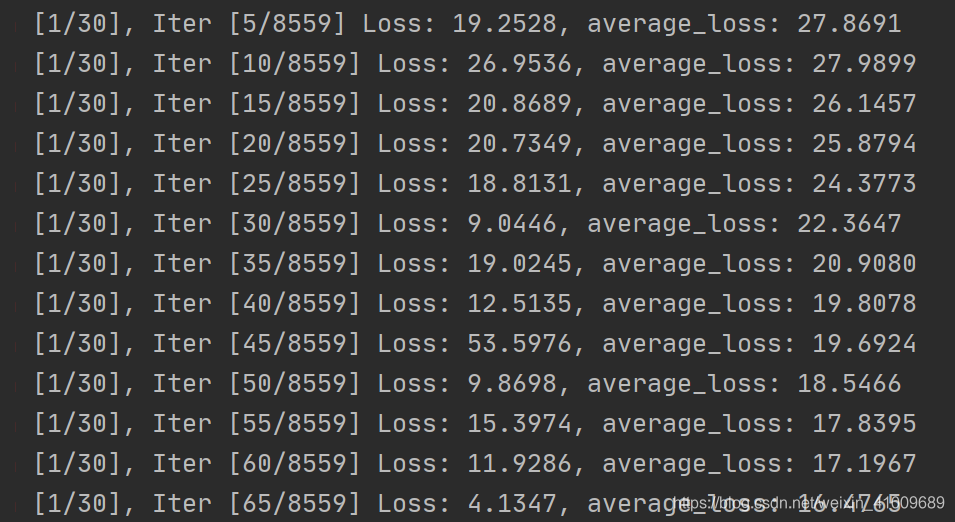
下面是开始训练了,但是训练的时候电脑风扇转的太快了,怕万一把电脑给跑废了这个假期没法儿做其他的了,训练了一部分就没有训练了。反正是学学思想和代码为以后有机会从事这个行业做准备。
预测
import torch
from torch.autograd import Variable

from resnet_yolo import resnet50
import torchvision.transforms as transforms
import cv2
import numpy as np

VOC_CLASSES = (    # always index 0
    'aeroplane', 'bicycle', 'bird', 'boat',
    'bottle', 'bus', 'car', 'cat', 'chair',
    'cow', 'diningtable', 'dog', 'horse',
    'motorbike', 'person', 'pottedplant',
    'sheep', 'sofa', 'train', 'tvmonitor')

Color = [[0, 0, 0],
         [128, 0, 0],
         [0, 128, 0],
         [128, 128, 0],
         [0, 0, 128],
         [128, 0, 128],
         [0, 128, 128],
         [128, 128, 128],
         [64, 0, 0],
         [192, 0, 0],
         [64, 128, 0],
         [192, 128, 0],
         [64, 0, 128],
         [192, 0, 128],
         [64, 128, 128],
         [192, 128, 128],
         [0, 64, 0],
         [128, 64, 0],
         [0, 192, 0],
         [128, 192, 0],
         [0, 64, 128]]


def decoder(pred):  # 在前面数据提取和加载部分我们有写过编码部分,是为了方便网络的训练,但是在最后的预测阶段我们需要框出图中的物体因此需要再转换成bbox[x1,y1,x2,y2]的格式
    '''
    pred (tensor) 1x7x7x30
    return (tensor) box[[x1,y1,x2,y2]] label[...]
    '''
    grid_num = 7
    boxes = []
    cls_indexs = []
    probs = []
    cell_size = 1. / grid_num
    pred = pred.data
    pred = pred.squeeze(0)  # 7x7x30
    contain1 = pred[:, :, 4].unsqueeze(2)
    contain2 = pred[:, :, 9].unsqueeze(2)
    contain = torch.cat((contain1, contain2), 2)
    mask1 = contain > 0.1  # 大于阈值
    # we always select the best contain_prob what ever it>0.9
    mask2 = (contain == contain.max())
    mask = (mask1 + mask2).gt(0)
    # min_score,min_index = torch.min(contain,2) #每个cell只选最大概率的那个预测框
    for i in range(grid_num):
        for j in range(grid_num):
            for b in range(2):
                # index = min_index[i,j]
                # mask[i,j,index] = 0
                if mask[i, j, b] == 1:
                    # print(i,j,b)
                    box = pred[i, j, b * 5:b * 5 + 4]
                    contain_prob = torch.FloatTensor([pred[i, j, b * 5 + 4]])
                    # cell左上角  up left of cell
                    xy = torch.FloatTensor([j, i]) * cell_size
                    # return cxcy relative to image
                    box[:2] = box[:2] * cell_size + xy
                    # 转换成xy形式    convert[cx,cy,w,h] to [x1,xy1,x2,y2]
                    box_xy = torch.FloatTensor(box.size())
                    box_xy[:2] = box[:2] - 0.5 * box[2:]
                    box_xy[2:] = box[:2] + 0.5 * box[2:]
                    max_prob, cls_index = torch.max(pred[i, j, 10:], 0)
                    if float((contain_prob * max_prob)[0]) > 0.1:
                        boxes.append(box_xy.view(1, 4))
                        cls_indexs.append(cls_index)
                        probs.append(contain_prob * max_prob)
    if len(boxes) == 0:
        boxes = torch.zeros((1, 4))
        probs = torch.zeros(1)
        cls_indexs = torch.zeros(1)
    else:
        boxes = torch.cat(boxes, 0)  # (n,4)
        probs = torch.cat(probs, 0)  # (n,)
        cls_indexs = torch.cat(cls_indexs, 0)  # (n,)
    keep = nms(boxes, probs)
    return boxes[keep], cls_indexs[keep], probs[keep]


def nms(bboxes, scores, threshold=0.5):
    '''
    bboxes(tensor) [N,4]
    scores(tensor) [N,]
    '''
    x1 = bboxes[:, 0]
    y1 = bboxes[:, 1]
    x2 = bboxes[:, 2]
    y2 = bboxes[:, 3]
    areas = (x2 - x1) * (y2 - y1)

    _, order = scores.sort(0, descending=True)
    keep = []
    while order.numel() > 0:
        i = order[0]
        keep.append(i)

        if order.numel() == 1:
            break

        xx1 = x1[order[1:]].clamp(min=x1[i])
        yy1 = y1[order[1:]].clamp(min=y1[i])
        xx2 = x2[order[1:]].clamp(max=x2[i])
        yy2 = y2[order[1:]].clamp(max=y2[i])

        w = (xx2 - xx1).clamp(min=0)
        h = (yy2 - yy1).clamp(min=0)
        inter = w * h

        ovr = inter / (areas[i] + areas[order[1:]] - inter)
        ids = (ovr <= threshold).nonzero().squeeze()
        if ids.numel() == 0:
            break
        order = order[ids + 1]
    return torch.LongTensor(keep)
#
# start predict one image
#


def predict_gpu(model, image_name, root_path=''):

    result = []
    image = cv2.imread(root_path + image_name)
    h, w, _ = image.shape
    img = cv2.resize(image, (448, 448))
    img = cv2.cvtColor(img, cv2.COLOR_BGR2RGB)
    mean = (123, 117, 104)  # RGB
    img = img - np.array(mean, dtype=np.float32)

    transform = transforms.Compose([transforms.ToTensor(), ])
    img = transform(img)
    img = Variable(img[None, :, :, :], volatile=True)
    img = img.cuda()

    pred = model(img)  # 1x7x7x30
    pred = pred.cpu()
    boxes, cls_indexs, probs = decoder(pred)

    for i, box in enumerate(boxes):
        x1 = int(box[0] * w)
        x2 = int(box[2] * w)
        y1 = int(box[1] * h)
        y2 = int(box[3] * h)
        cls_index = cls_indexs[i]
        cls_index = int(cls_index)  # convert LongTensor to int
        prob = probs[i]
        prob = float(prob)
        result.append(
            [(x1, y1), (x2, y2), VOC_CLASSES[cls_index], image_name, prob])
    return result


if __name__ == '__main__':
    model = resnet50()
    print('load model...')
    model.load_state_dict(torch.load('best.pth'))
    model.eval()
    model.cuda()
    image_name = 'dog.jpg'
    image = cv2.imread(image_name)
    print('predicting...')
    result = predict_gpu(model, image_name)
    for left_up, right_bottom, class_name, _, prob in result:
        color = Color[VOC_CLASSES.index(class_name)]
        cv2.rectangle(image, left_up, right_bottom, color, 2)
        label = class_name + str(round(prob, 2))
        text_size, baseline = cv2.getTextSize(
            label, cv2.FONT_HERSHEY_SIMPLEX, 0.4, 1)
        p1 = (left_up[0], left_up[1] - text_size[1])
        cv2.rectangle(image, (p1[0] -
                              2 //
                              2, p1[1] -
                              2 -
                              baseline), (p1[0] +
                                          text_size[0], p1[1] +
                                          text_size[1]), color, -
                      1)
        cv2.putText(
            image,
            label,
            (p1[0],
             p1[1] +
                baseline),
            cv2.FONT_HERSHEY_SIMPLEX,
            0.4,
            (255,
             255,
             255),
            1,
            8)

    cv2.imwrite('result.jpg', image)
这个是yolo v1的一个比较简单的实现,是为了能够理解Yolo的思想,还有一些训练数据可视化的操作等这里就不写了。
更多推荐

 6
6 0
0- 0


 已为社区贡献4条内容

所有评论(0)