
论文阅读理解 - Dilated Convolution
Dilated Convolution
[Paper]: Multi-scale Context Aggregation by Dilated Convolutions
1. Caffe 中的定义
Dilated Convolution 已经可在 Caffe 官方的卷积层参数中定义.
message ConvolutionParameter {
  // Factor used to dilate the kernel, (implicitly) zero-filling the resulting holes.
  // (Kernel dilation is sometimes referred to by its use in the
  //  algorithme à trous from Holschneider et al. 1987.)
  repeated uint32 dilation = 18; // The dilation; defaults to 1
}
layer {
name: "ct_conv1_1"
type: "Convolution"
bottom: "fc-final"
top: "ct_conv1_1"
param {
lr_mult: 1
decay_mult: 1
}
param {
lr_mult: 2
decay_mult: 1
}
convolution_param {
num_output: 42
pad: 33
kernel_size: 3
}
}
layer {
name: "ct_relu1_1"
type: "ReLU"
bottom: "ct_conv1_1"
top: "ct_conv1_1"
}
layer {
name: "ct_conv1_2"
type: "Convolution"
bottom: "ct_conv1_1"
top: "ct_conv1_2"
param {
lr_mult: 1
decay_mult: 1
}
param {
lr_mult: 2
decay_mult: 1
}
convolution_param {
num_output: 42
pad: 0
kernel_size: 3
}
}
layer {
name: "ct_relu1_2"
type: "ReLU"
bottom: "ct_conv1_2"
top: "ct_conv1_2"
}
layer {
name: "ct_conv2_1"
type: "Convolution"
bottom: "ct_conv1_2"
top: "ct_conv2_1"
convolution_param {
num_output: 84
kernel_size: 3
dilation: 2
}
}
layer {
name: "ct_relu2_1"
type: "ReLU"
bottom: "ct_conv2_1"
top: "ct_conv2_1"
}
layer {
name: "ct_conv3_1"
type: "Convolution"
bottom: "ct_conv2_1"
top: "ct_conv3_1"
convolution_param {
num_output: 168
kernel_size: 3
dilation: 4
}
}
layer {
name: "ct_relu3_1"
type: "ReLU"
bottom: "ct_conv3_1"
top: "ct_conv3_1"
}
layer {
name: "ct_conv4_1"
type: "Convolution"
bottom: "ct_conv3_1"
top: "ct_conv4_1"
convolution_param {
num_output: 336
kernel_size: 3
dilation: 8
}
}
layer {
name: "ct_relu4_1"
type: "ReLU"
bottom: "ct_conv4_1"
top: "ct_conv4_1"
}
layer {
name: "ct_conv5_1"
type: "Convolution"
bottom: "ct_conv4_1"
top: "ct_conv5_1"
convolution_param {
num_output: 672
kernel_size: 3
dilation: 16
}
}
layer {
name: "ct_relu5_1"
type: "ReLU"
bottom: "ct_conv5_1"
top: "ct_conv5_1"
}
layer {
name: "ct_fc1"
type: "Convolution"
bottom: "ct_conv5_1"
top: "ct_fc1"
convolution_param {
num_output: 672
kernel_size: 3
}
}
layer {
name: "ct_fc1_relu"
type: "ReLU"
bottom: "ct_fc1"
top: "ct_fc1"
}
layer {
name: "ct_final"
type: "Convolution"
bottom: "ct_fc1"
top: "ct_final"
convolution_param {
num_output: 21
kernel_size: 1
}
}2. Paper - Multi-scale Context Aggregation by Dilated Convolutions
语义分割属于 dense prediction 问题, 不同于图像分类问题.
Dilated Convolutions 能够整合多尺度内容信息,且不损失分辨率,支持接受野的指数增长.
图像分类任务通过连续的 Pooling 和 Subsampling 层整合多尺度的内容信息,降低图像分别率,以得到全局预测输出.
Dense Prediction 需要结合多尺度内容推理(multi-scale contextual reasoning)与 full-resolution 输出.
处理 multi-scale reasoning 与 full-resolution dense prediction 冲突的方法:
- 利用重复的 up-convolutions 操作,重构丢失的分辨率,保留downsampled 层的全局信息.
- 利用图像不同 rescaled 的信息作为网络输入,并结合其输出. 不过无法确定哪个 rescaled 输入图像是最需要的.
Dilated Convolutions 不会降低图像分辨率,或分析 rescaled 图像,整合了多尺度的内容信息. 可以以任何分辨率加入到已有的网络结构中.
2.1 Dilated Convolution
定义离散函数: F:Z2→R F : Z 2 → R <script type="math/tex" id="MathJax-Element-79">F: Z^2 \rightarrow R</script>, 假设 Ωr=[−r,r]2⋂Z2 Ω r = [ − r , r ] 2 ⋂ Z 2 <script type="math/tex" id="MathJax-Element-80">\Omega _r = [-r, r]^2 \bigcap Z^2</script>, k:Ω→R k : Ω → R <script type="math/tex" id="MathJax-Element-81">k: \Omega \rightarrow R</script> 是大小为 (2r+1)2 ( 2 r + 1 ) 2 <script type="math/tex" id="MathJax-Element-82">(2r+1)^2</script> 的离散 filter. 则离散卷积操作 ∗ ∗ <script type="math/tex" id="MathJax-Element-83">*</script> 的定义为:
<script type="math/tex" id="MathJax-Element-84">(F*k)(\mathbf{p}) = \sum_{\mathbf{s} + \mathbf{t}= \mathbf{p}}</script> .
其一般化形式为:
(F∗lk)(p)=∑s+lt=p ( F ∗ l k ) ( p ) = ∑ s + l t = p <script type="math/tex" id="MathJax-Element-85">(F*_lk)(\mathbf{p}) = \sum_{\mathbf{s} + l\mathbf{t}= \mathbf{p}}</script>
其中 l l <script type="math/tex" id="MathJax-Element-86">l</script> 为 dilation 因子,<script type="math/tex" id="MathJax-Element-87">*_l</script> 为 dilation convolution. 当 l=1 l = 1 <script type="math/tex" id="MathJax-Element-88">l=1</script> 时,即为普通的离散卷积操作 ∗ ∗ <script type="math/tex" id="MathJax-Element-89">*</script>.
基于 Dilation Convolution 的网络支持接受野的指数增长,不丢失分辨率信息.
记 <script type="math/tex" id="MathJax-Element-90">F_0, F_1, ..., F_{n-1} : Z^2 \rightarrow R</script> 为离散函数, k0,k1,...,kn−2:Ω→R k 0 , k 1 , . . . , k n − 2 : Ω → R <script type="math/tex" id="MathJax-Element-91">k_0, k_1, ... ,k_{n-2} : \Omega \rightarrow R</script> 是离散的 3×3 3 × 3 <script type="math/tex" id="MathJax-Element-92">3×3</script> fliters, 采用指数增长 dilation 的 filters后,
Fi+1=Fi∗2iki, for i=0,1,...,n−2 F i + 1 = F i ∗ 2 i k i , f o r i = 0 , 1 , . . . , n − 2 <script type="math/tex" id="MathJax-Element-93">F_{i+1} = F_i *_{2^i} k_i, \space for \space i = 0, 1, ..., n-2</script>
定义 Fi+1 F i + 1 <script type="math/tex" id="MathJax-Element-94">F_{i+1}</script> 中的元素 p p <script type="math/tex" id="MathJax-Element-95">\mathbf{p}</script> 的接受野为: F0 F 0 <script type="math/tex" id="MathJax-Element-96">F_0</script> 中可以改变 Fi+1(p) F i + 1 ( p ) <script type="math/tex" id="MathJax-Element-97">F_{i+1}(\mathbf{p})</script> 值的元素集. Fi+1 F i + 1 <script type="math/tex" id="MathJax-Element-98">F_{i+1}</script> 中 p p <script type="math/tex" id="MathJax-Element-99">\mathbf{p}</script> 的接受野的大小即为这些元素集的数目.
显而易见, Fi+1 F i + 1 <script type="math/tex" id="MathJax-Element-100">F_{i+1}</script> 中各元素的接受野大小为 (2i+2−1)×(2i+2−1) ( 2 i + 2 − 1 ) × ( 2 i + 2 − 1 ) <script type="math/tex" id="MathJax-Element-101">(2^{i+2} - 1) × (2^{i+2} - 1)</script>. 接受野是指数增长大小的平方.
如图 Figure1.
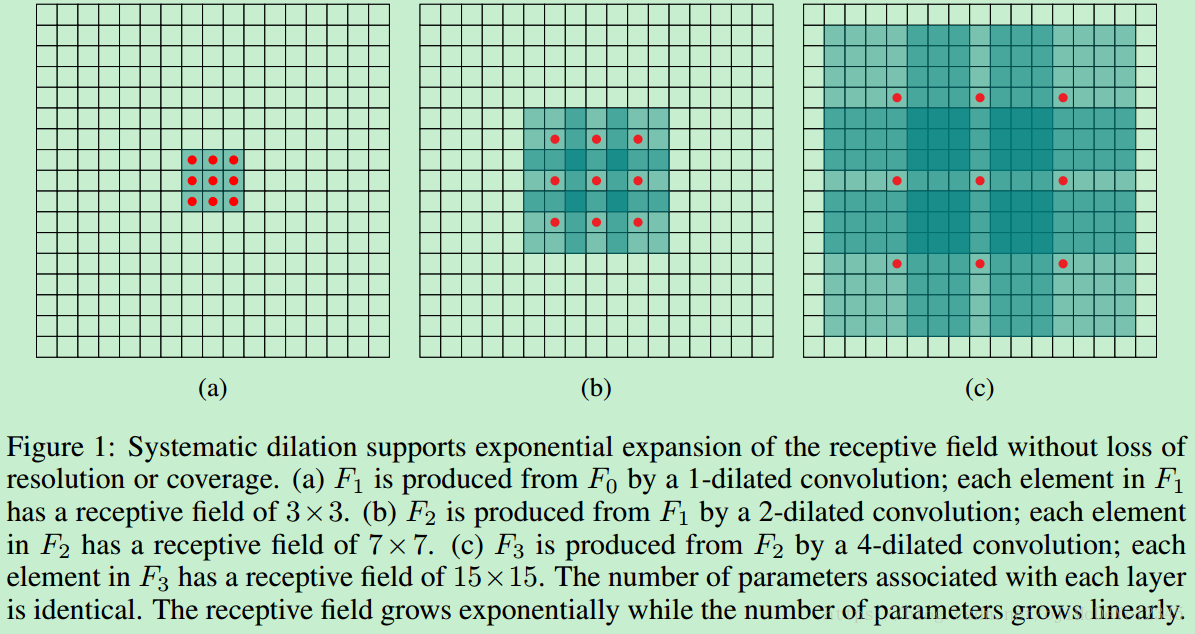
Figure1:Dilated Convolution例示.
(a) 采用 1-dilated convolution 对 F0 F 0 <script type="math/tex" id="MathJax-Element-102">F_0</script> 操作得到的 F1 F 1 <script type="math/tex" id="MathJax-Element-103">F_1</script>, F1 F 1 <script type="math/tex" id="MathJax-Element-104">F_1</script> 中各元素的接受野为 3×3 3 × 3 <script type="math/tex" id="MathJax-Element-105">3×3</script>.
(b) 采用 2-dilated convolution 对 F1 F 1 <script type="math/tex" id="MathJax-Element-106">F_1</script> 操作得到的 F2 F 2 <script type="math/tex" id="MathJax-Element-107">F_2</script>, F2 F 2 <script type="math/tex" id="MathJax-Element-108">F_2</script> 中各元素的接受野为 7×7 7 × 7 <script type="math/tex" id="MathJax-Element-109">7×7</script>.
(c) 采用 4-dilated convolution 对 F2 F 2 <script type="math/tex" id="MathJax-Element-110">F_2</script> 操作得到的 F3 F 3 <script type="math/tex" id="MathJax-Element-111">F_3</script>, F3 F 3 <script type="math/tex" id="MathJax-Element-112">F_3</script> 中各元素的接受野为 15×15 15 × 15 <script type="math/tex" id="MathJax-Element-113">15×15</script>.
各层的参数数量是相同的. 随着参数的线性增加,接受野指数增长.
2.2 多尺度内容信息聚合(Multi-scale Context Aggreation)
context 模块通过整合多尺度内容信息来提高 dense prediction 的结果. 其输入是
C
C
<script type="math/tex" id="MathJax-Element-126">C</script> 个特征图(feature maps), 输出也是 <script type="math/tex" id="MathJax-Element-127">C</script> 个特征图,输入输出的形式相同.
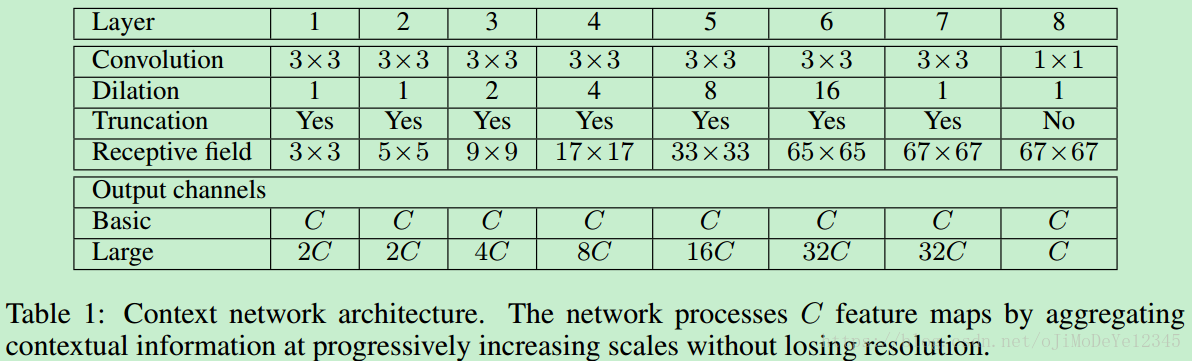
context 模块的基本形式中,各层具有 C C <script type="math/tex" id="MathJax-Element-128">C</script> 个 channels. 尽管特征图没有归一化,模块内也没有定义loss,但各层的表示是相同的,可以直接用于获得 dense per-class prediction. 直观上是可以增加特征图的准确度的.
基本的 context 模块有 7 层,各层采用具有不同的 dilation 因子的 <script type="math/tex" id="MathJax-Element-129">3×3</script> 卷积. 各卷积操作后跟着一个逐元素截断(pointwise truncation)操作: max(⋅,0) m a x ( ⋅ , 0 ) <script type="math/tex" id="MathJax-Element-130">max(\cdot, 0)</script>. 最终的输出是采用 1×1×C 1 × 1 × C <script type="math/tex" id="MathJax-Element-131">1×1×C</script> 的卷积操作得到的.
3. Reference
[1] - caffe::ConvolutionLayer
[2] - Multi-scale context aggregation by dilated convolutions
更多推荐


 1
1 0
0- 0


 已为社区贡献4条内容

所有评论(0)